

Flagship analysis
The Return of the Cost of Capital
Why higher real yields may matter more for investors than the next central-bank decision.
The world needs more capital precisely when capital has become more expensive.
A More Capital-Intensive World
Higher real rates, AI infrastructure, energy constraints and geopolitical fragmentation are converging into a new investment regime. The key question may no longer be who grows fastest — but who controls scarce assets, and at what return on invested capital.
NXFinance Investment Intelligence · September 2026
For much of the 2010s, capital allocation was shaped by a remarkably favorable combination: low interest rates, abundant global liquidity, cheap energy, increasingly efficient supply chains and business models designed to minimize physical capital.
The dominant corporate vocabulary reflected that environment: asset-light, outsourcing, just-in-time, cloud, platforms, scalability.
That regime is being challenged.
Across seemingly unrelated developments — sovereign bond markets, artificial intelligence, energy, industrial policy and geopolitics — the same underlying force is becoming visible:
The global economy is becoming more capital-intensive.
This matters because capital intensity changes the economics of growth.
When capital is cheap, growth itself can dominate the investment narrative. When capital becomes expensive, growth must increasingly be judged against the amount of capital required to generate it — and the return earned on that capital.
That makes discount rates, scarcity, financing structures and incremental ROIC increasingly important variables for investors.
1. The cost of capital is back
The first signal comes from the bond market.
The U.S. economy continues to show enough resilience to complicate the simple monetary-policy narrative that dominated expectations during previous slowdowns:
slower growth → easier Fed → lower rates → higher asset valuations.
That sequence is no longer guaranteed.
At the same time, energy prices are again feeding inflation concerns, while sovereign borrowing requirements remain substantial. Long-term yields therefore increasingly reflect forces extending beyond the expected path of central-bank policy.
The important distinction is between the policy rate and the cost of long-duration capital.
A central bank can eventually reduce short-term rates without necessarily returning the entire yield curve to the exceptionally low levels that characterized the post-financial-crisis period.
Fiscal deficits, sovereign issuance, inflation uncertainty and term premia all matter.
And real yields matter even more for valuation.
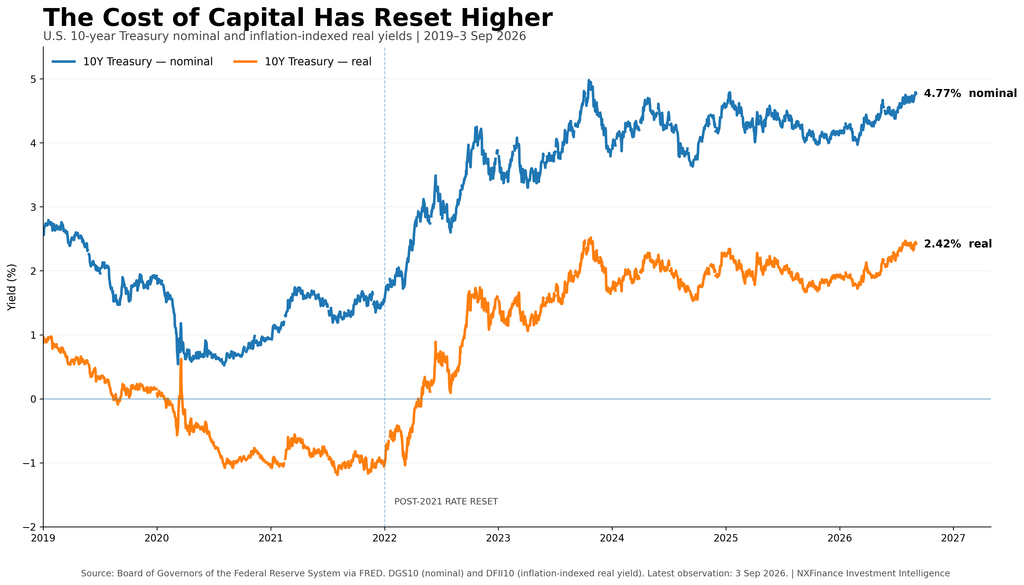
A structurally higher real risk-free rate changes the hurdle rate against which virtually every investment must compete.
An equity valued at 35 times earnings, an infrastructure asset, a leveraged buyout, commercial real estate or a data center project must ultimately justify its price relative to an increasingly attractive risk-free alternative.
This does not mean that high-quality growth assets suddenly become unattractive.
It means that quality and price must once again be separated.
An exceptional company can be a poor investment when its valuation implicitly assumes a cost of capital that no longer exists.
For capital allocators, the discount rate has returned from the footnotes to the center of the investment decision.
2. This is not simply a Federal Reserve story
The second development is more structural.
For years, investors could simplify a large part of global fixed-income analysis into something resembling:
Fed → U.S. yields → global yields.
That framework is becoming insufficient.
Japan is particularly important.
As Japanese domestic yields rise toward levels not seen for decades, Japanese investors face a different allocation equation. Domestic government bonds can become economically meaningful alternatives to foreign fixed-income assets.
The mechanism is straightforward:
higher Japanese yields → greater relative attractiveness of JGBs → less structural need to export capital.
At the same time, large global asset owners are reassessing the composition of their sovereign exposures, while the United States continues to require enormous amounts of financing.
The issue is therefore not simply whether the Federal Reserve moves rates by 25 basis points.
The deeper question is:
Who will provide the marginal capital required to finance expanding sovereign balance sheets — and at what price?
If traditional foreign buyers become even modestly less price-insensitive, term premia may need to do more of the adjustment.
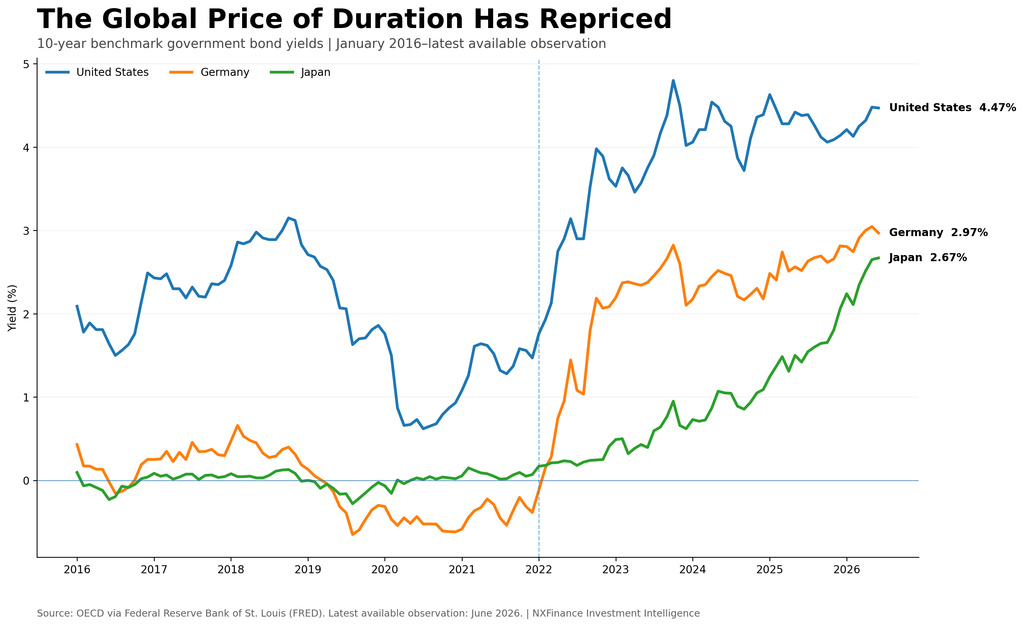
This would have consequences far beyond government bonds.
Sovereign curves sit underneath the pricing of mortgages, corporate debt, infrastructure, private equity and equities themselves.
A persistent increase in the global price of duration therefore represents a valuation regime change, not merely a bond-market event.
3. Artificial intelligence is becoming physical
At first, the AI investment story was largely framed through venture capital and software.
Then it became a Big Tech capital-expenditure story.
The scale of that shift is now becoming visible in corporate capital budgets.
Amazon expects to deploy roughly $200 billion of capital expenditure in 2026, after reporting $131.8 billion of property and equipment purchases in 2025. Alphabet now expects approximately $195–205 billion of capital expenditure in 2026, after spending $91.4 billion in 2025. Meta expects $130–145 billion, compared with $72.2 billion in 2025. Microsoft, meanwhile, is operating at an unprecedented infrastructure investment run-rate as cloud and AI capacity requirements continue to expand.
These figures are not perfectly comparable across companies, and they should not be interpreted as pure AI spending. But the direction is unmistakable.
AI is no longer primarily a software investment cycle. It is becoming one of the largest physical capital-deployment cycles in modern corporate history.
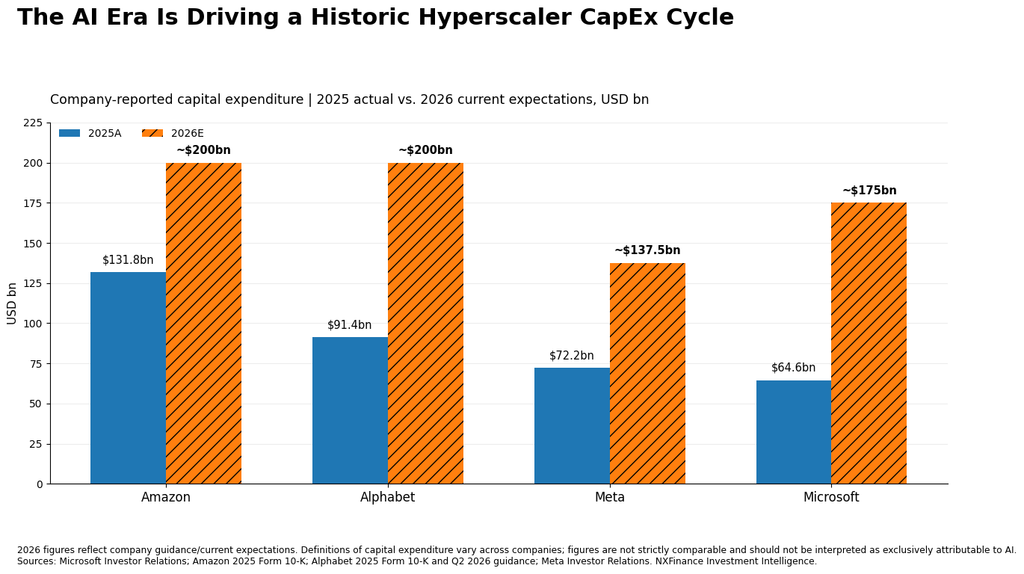
The AI Era Is Driving a Historic Hyperscaler CapEx Cycle
Large-scale compute requires data centers.
Data centers require semiconductors, servers, networking equipment, cooling systems, land, grid connections and enormous amounts of electricity.
Across this value chain, different companies play very different economic roles. Semiconductor designers such as NVIDIA supply critical compute technology; foundries manufacture the chips; hyperscalers such as Microsoft, Amazon, Alphabet and Meta deploy them at scale through data centers and cloud infrastructure; while utilities and infrastructure providers supply the power and physical capacity required to operate them.
The hyperscalers therefore provide a useful window into how rapidly AI is translating into actual capital deployment.
But the implications extend beyond technology companies themselves.
The next stage is becoming increasingly visible:
AI is entering the industrial financing system.
Building compute capacity at this scale requires enormous amounts of capital. And as individual infrastructure programs reach tens of billions of dollars, financing can no longer be viewed solely through the lens of retained earnings or venture capital.
The financing ecosystem increasingly expands toward corporate debt, syndicated lending, infrastructure finance, project structures, guarantees and long-duration contracted capital.
In that sense, the economics of AI are beginning to resemble an unusual combination of:
software + semiconductors + telecom + utilities + infrastructure.
That distinction matters enormously for investors.
Software economics encourage attention to marginal costs, recurring revenue, customer acquisition and scalability.
Infrastructure economics demand another set of questions:
How much capacity is being built?
At what cost?
At what utilization rate?
Who finances it?
How long are customer commitments?
What happens to compute pricing as capacity expands?
What is the cost and availability of electricity?
And, ultimately:
What incremental return on invested capital will this enormous AI capital expenditure generate?
That may become one of the defining investment questions of the AI era.
Because spending $100 billion, $150 billion or $200 billion on infrastructure does not create value by itself.
It creates value only if the future cash flows generated by that infrastructure justify the capital committed to build it.
And in a world where the risk-free rate has reset materially above the levels that prevailed during the previous decade, that hurdle is becoming harder — not easier — to clear.
The defining tension of the emerging investment regime may be that the world is becoming more capital-intensive precisely as capital itself has become more expensive.
4. Geopolitical fragmentation has a capital cost
The same logic extends beyond technology.
For decades, globalization optimized production around efficiency.
A component could be produced wherever the combination of labor, expertise, infrastructure and logistics made it cheapest. Inventories could be minimized. Supply chains could be concentrated. Redundancy looked inefficient.
National security is now reversing part of that logic.
Semiconductors, critical minerals, defense systems, telecommunications equipment and energy infrastructure are increasingly treated not simply as tradable goods, but as strategic capabilities.
The resulting system does not necessarily imply complete U.S.–China economic separation. A more plausible outcome is selective fragmentation.
Some supply chains will remain global. Others will increasingly operate under explicit security, resilience or sovereignty constraints.
But resilience costs money.
Two suppliers instead of one.
Additional inventories.
Alternative shipping routes.
Domestic semiconductor capacity.
Strategic mineral processing.
LNG terminals.
Pipelines.
Defense production.
Backup generation.
Grid reinforcement.
Each represents a different response to the same underlying problem: reducing dependence on a single source of supply requires additional productive capacity, redundancy or infrastructure.
The economic consequence can therefore be summarized simply:
Redundancy reduces efficiency but increases resilience — and resilience requires capital.
This is one reason geopolitical fragmentation can remain structurally inflationary even without a permanent breakdown in world trade. More resilient systems may be safer, but they are also more expensive to build and maintain.
And once again, the investment question eventually returns to capital allocation: who will finance that additional capacity, at what cost, and at what return?
5. Energy connects the entire system
Energy is the transmission mechanism linking many of these forces.
An energy shock does not stop at the oil market. Its effects propagate through the economic and financial system:
geopolitics → shipping → oil → refining → fuel → inflation → monetary policy → bond yields → discount rates → valuations.
Energy is therefore simultaneously an operating cost, an inflation variable, a geopolitical asset and a financial input.
But the emerging capital cycle adds another dimension.
AI data centers require electricity. Semiconductor fabrication requires energy and water. Supply-chain duplication requires new industrial capacity. Defense production requires manufacturing capacity. Energy security itself requires grids, generation, storage, pipelines and other physical infrastructure.
Capital therefore does not operate independently of physical constraints. Increasingly, the ability to deploy capital productively depends on access to energy, grids and infrastructure.
The scale of the challenge is already becoming visible.
Global data-center electricity consumption reached approximately 485 TWh in 2025. Under the IEA’s base case, it rises to approximately 945 TWh by 2030 — almost twice the 2025 level in only five years — and reaches roughly 1,193 TWh by 2035.
The range of possible outcomes is wide. That uncertainty is itself important: the ultimate electricity requirement will depend on the pace of AI adoption, efficiency improvements, utilization rates, hardware development and the speed at which new infrastructure can actually be deployed.
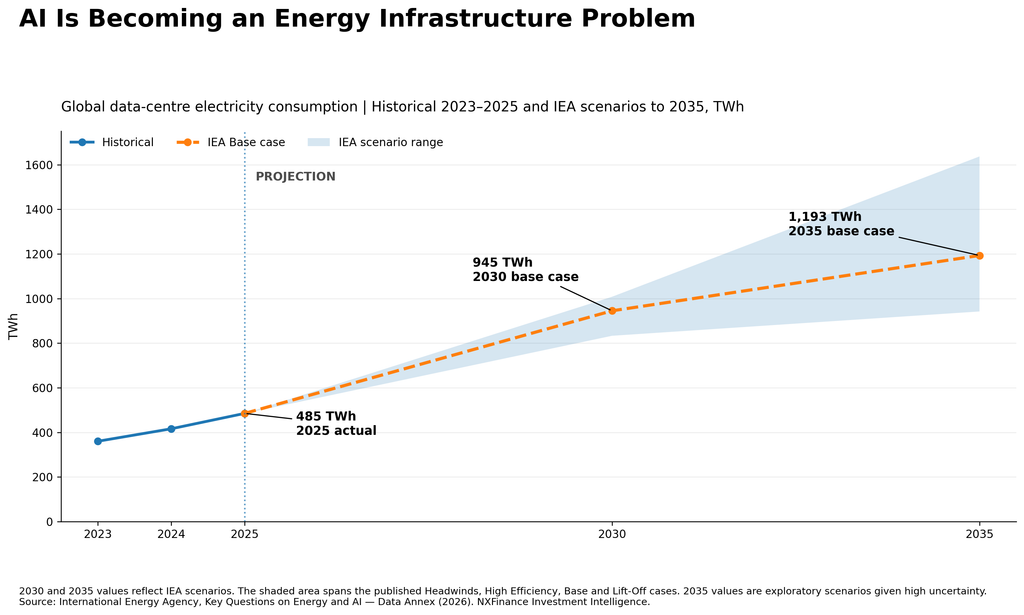
AI Is Becoming an Energy Infrastructure Problem
Global data-centre electricity consumption | Historical 2023–2025 and IEA scenarios to 2035, TWh
The investment implication is not simply “buy energy.”
It is more fundamental:
energy availability and infrastructure increasingly constrain the returns available elsewhere in the economy.
A data center without sufficient grid capacity has little economic value.
A semiconductor fab without reliable electricity cannot monetize its technological sophistication.
A factory cannot generate attractive returns if the infrastructure required to operate it becomes prohibitively expensive.
And a hyperscaler deploying hundreds of billions of dollars into compute infrastructure ultimately depends on physical systems — electricity generation, transmission, cooling, land and connectivity — that cannot scale at software speed.
This creates an important asymmetry.
Digital demand can accelerate extremely quickly. Physical capacity cannot.
Software can be deployed globally in months. Data centers take longer. Power plants, transmission lines, grid connections and large industrial projects can take years.
That difference in adjustment speeds can create bottlenecks.
And bottlenecks matter because scarcity at one layer can determine returns throughout the entire value chain.
The relevant investment question therefore extends beyond identifying where demand is growing.
It becomes:
Who controls the scarce physical capacity required to satisfy that demand — and what return can be earned on the capital required to expand it?
From Growth Investing to Capital Productivity
Put these developments together and a coherent investment regime begins to emerge.
Resilient growth + energy pressure → rates remain restrictive.
Large sovereign financing needs + changing foreign demand → higher term premia.
AI → capex → financing → infrastructure economics.
Geopolitical fragmentation → redundancy → additional capital requirements.
Each force is different.
But they increasingly converge on the same underlying issue:
The world needs more capital precisely when capital has become more expensive.
None of these forces guarantees permanently higher inflation or permanently higher interest rates.
Technology may improve energy efficiency. Productivity gains from AI may eventually offset part of the capital required to build it. Monetary conditions will continue to fluctuate. Geopolitical tensions can ease as well as intensify.
The argument is therefore not that one macroeconomic outcome has become inevitable.
It is that several structural forces are weakening one of the central assumptions embedded in many investment strategies developed during the 2010s:
that capital would remain extraordinarily cheap and physical capacity abundant.
The next regime may reward a different analytical framework.
Revenue growth still matters.
Margins still matter.
Technology still matters.
But investors may increasingly need to ask what sits underneath them:
How much capital is required to generate the next dollar of earnings?
Who finances that capital?
At what cost?
Which assets are genuinely scarce?
Who possesses pricing power over those bottlenecks?
And what return is earned on the incremental capital deployed?
That brings the analysis back to one of the oldest disciplines in finance:
capital allocation.
The companies and assets that matter most over the next decade may not simply be those growing fastest.
They may be those capable of controlling scarce infrastructure while reinvesting large amounts of capital at returns persistently above their cost of capital.
The world emerging today looks less optimized, less frictionless and less asset-light.
But it may also create extraordinary opportunities for owners of productive scarcity.
The world is becoming less efficient — but much more capital-intensive.
For investors, the defining question may therefore be changing from:
“Who grows fastest?”
to:
