
NXFinance / Investment Intelligence
Who Governs Capital?
Power, financial discipline and the future societies choose
Why would an intelligence agency want a sociopath?
The question sounds more certain than the evidence permits. In a 2015 interview, former CIA officer John Kiriakou recalled a CIA psychiatrist telling him that the agency looked for people with what the psychiatrist called “sociopathic tendencies”: people comfortable operating in moral or legal gray areas. It is Kiriakou’s account of a conversation, not independent proof of a general CIA recruitment policy. Neither his language nor the alleged psychiatrist’s description establishes a clinical diagnosis. [1]
But the question has a life beyond the agency. Organizations reward people for winning difficult contests. They promote those who secure resources, navigate rivalries and survive pressure. These abilities can be valuable. They are not necessarily the same as the judgment required to use power responsibly.
The distinction becomes expensive when the power in question is the power to commit capital.
A minister controls a sovereign investment program. An entrepreneur inherits a dominant business. A banker decides which borrower receives another loan. A board approves an acquisition with other people’s savings. Each may possess authority, intelligence and experience. None of those facts, on its own, proves that the next decision will create value.
Capital can build a power grid, finance a medicine or turn a small enterprise into an international competitor. It can also preserve a protected position, finance an acquisition that should never have happened or sustain an institution whose principal achievement is survival. The difference affects more than a balance sheet. It shapes which opportunities a society can pursue and which it leaves unexplored.
That is why the question “Who governs capital?” is not a metaphor. Someone decides. The real questions are who gave them that authority, what information they use, whose interests matter and what happens when they are wrong.
The right to decide
Plato’s philosopher-rulers express an attractive hope: decisions of consequence should be made by people capable of understanding them. Expertise matters. No serious investor wants a committee that considers ignorance an asset.
The difficulty begins with a practical question: who identifies the wise, and who challenges them after they receive power?
Machiavelli approached authority from another direction. A ruler must understand how power is acquired, exercised and preserved. Political life contains rivalry, uncertainty and self-interest. Good intentions do not remove them. A financial institution that ignores incentives is not morally superior; it is merely less prepared.
John Locke gave a different answer about legitimacy, emphasizing property, consent and limits on government. The owner of capital has a claim to direct it. That claim is significant: people are unlikely to save and invest for the long term if their rights can be disregarded at will. Yet ownership does not settle every question about consequences for employees, creditors, customers or those exposed to harm.
Ruhollah Khomeini’s doctrine of velayat-e faqih, the guardianship of the jurist, locates political authority in a different account of religious law and qualified interpretation. Its foundation is neither Locke’s theory of consent nor a neutral claim that technical experts should run companies. Comparing the two reveals a disagreement about where authority originates and how it is bounded. It does not make them interchangeable.
Who appoints the wise? More interestingly, who gets to tell them they are wrong? A claim to superior knowledge may establish authority. It does little to protect against the consequences of a bad decision—especially when that decision determines which businesses receive capital, which ideas survive, and which opportunities never get the chance to prove themselves.
Karl Popper shifted attention toward the fallibility of rulers and the possibility of criticism and peaceful correction. Friedrich Hayek emphasized that economically useful knowledge is dispersed: a manufacturer, a customer, a banker and a supplier each know things that no single authority can easily assemble. The lesson is not that expertise is dangerous or that markets are always right. It is that confidence becomes more valuable when it is exposed to disagreement.
These thinkers did not leave us a corporate governance manual. They left a more basic problem: authority, knowledge and legitimacy are different things. A person can possess one without possessing the others.
Four centuries ago, an investor in Amsterdam found that distinction difficult to ignore.
Isaac and the company that would not let go
The Dutch East India Company, or VOC, was established in 1602 with state-backed privileges over Dutch trade in parts of Asia. Its enterprise demanded ships, crews, commercial networks and substantial financing. Investors subscribed capital to an undertaking larger and riskier than many merchants could finance alone.
The arrangement also made a consequential distinction possible. An investor could transfer a claim to another investor while the company continued to use the underlying capital. A share could change hands without a ship returning to port. Liquidity for an owner did not automatically mean liquidation of the enterprise.
Isaac Le Maire was one of the company’s original directors and a major shareholder. He resigned in 1605 following allegations of embezzlement. This is not the beginning of a story about a flawless defender of minority investors.
The company’s early charter contemplated a ten-year account and a reckoning around 1612. In a 2026 study, historians Oscar Gelderblom, Abe de Jong and Joost Jonker reconstruct how the company committed resources to military operations against Spanish and Portuguese rivals and sought continuation of that account. By 1609, they argue, it had become apparent that the expected liquidation would not proceed as initially contemplated. The question was no longer only how much money the company might earn. It was how long its directors and their political backers could direct the capital, and toward what ends. [2]
Le Maire had his own answer. In 1609 he and other merchants organized forward sales of VOC shares. His partners stood to gain if prices fell. The historians argue that Le Maire also had a strategic interest in breaking the VOC monopoly, including through a possible rival enterprise. Company directors opposed the group; an opposing syndicate took positions of its own. A dividend in spice helped squeeze the short sellers in 1610, and several traders became bankrupt. The researchers challenge older accounts that described Le Maire’s group as secret and show that authorities initially declined the company’s request to prohibit the trade. [2]
The drama becomes less comfortable when we remember what the VOC was financing. Its commercial privileges were tied to state power, military force and colonial coercion. People living in the territories affected by its expansion had no equivalent claim to the decision table. The company’s financial innovations cannot be separated from the coercive conditions in which it operated; neither should the whole episode be reduced to an allegory of good shareholders and bad managers.
What survives the distance from Amsterdam to a modern boardroom is the structure of the conflict. Capital had been committed. Decision-makers possessed different mandates. Owners could trade claims but could not necessarily recover the assets on demand. Information was incomplete, interests diverged and the state had objectives of its own.
The VOC was not a modern corporation accidentally born early. It was an institution built for its own time. Yet its conflicts expose a question every investment committee still faces: who gets to decide what committed capital is for?
Power learns to account
Capital needs more than ambition. It needs some way to record promises, identify obligations, preserve claims and discover whether a decision worked.
Societies developed such tools in different places and at different times. Records of trade and debt long predate Renaissance Europe. Double-entry bookkeeping, described by Luca Pacioli in 1494, contributed a systematic method for connecting accounts. It did not invent accounting, and a ledger did not confer moral legitimacy on the person holding the pen. Contracts, commercial law, reporting and audit evolved in distinct institutional settings rather than along a single universal path. [3]
These instruments made certain questions harder to evade. Where did the money go? What is owed? What remains? The more reliably a claim can be recorded and enforced, the more readily people can cooperate across distance and time. That can help finance enterprises larger than a family’s immediate resources. It can also make it easier for powerful actors to organize harmful activity. An instrument inherits the purposes and constraints of those who use it.
Accounting improved the traceability of what happened. Financial valuation added another question: was that use of resources preferable to an available alternative, given time and risk?
This is a demanding question because every major commitment excludes something. Capital invested in one factory cannot simultaneously finance a second factory. Credit extended to one borrower uses a bank’s capacity. A state budget devoted to a subsidy has another possible use. Even doing nothing can be a decision: cash preserves flexibility, but it also forgoes opportunities and may lose purchasing power.
Irving Fisher’s work on interest and investment helped formalize choices across time. Modern finance developed a broader set of tools for relating future cash flows, risk and opportunity cost. The techniques can become elaborate; their basic challenge is direct. Show what a decision is expected to produce, when, at what risk and compared with what alternative.
The obligation to explain does not arise only because a model exists. It arises because someone has the power to commit scarce resources and because other people live with the consequences.
But the analyst’s authority has limits. Measurement can make a choice more transparent. It cannot decide by itself whether the purpose of the choice is just.
The business that makes money and loses value
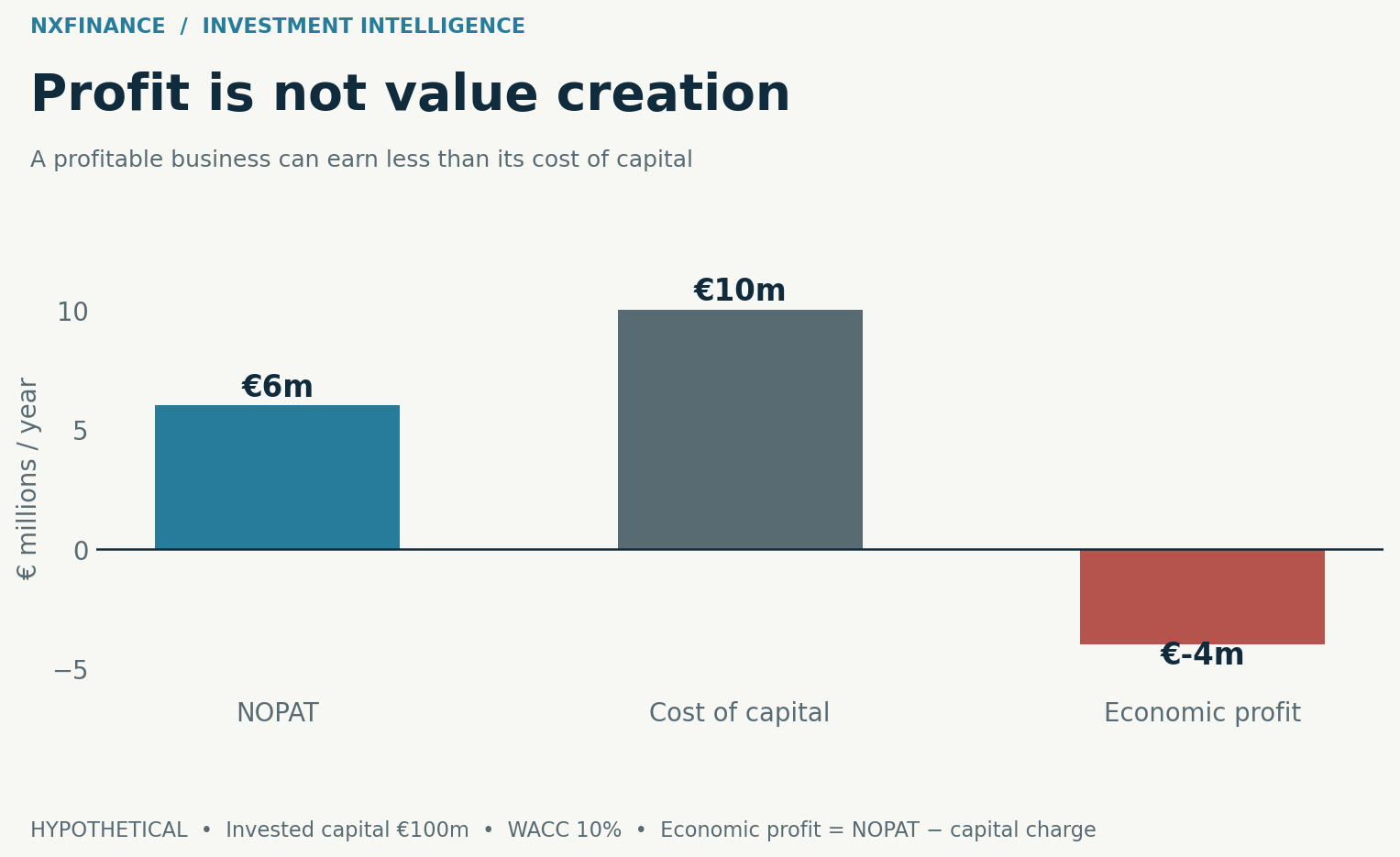
Imagine a company with €100 million of invested operating capital. After operating costs and taxes, it produces €6 million of annual net operating profit after tax, or NOPAT. Its return on invested capital—NOPAT divided by invested capital—is 6%.
Now assume the relevant weighted average cost of capital is 10%. On these simplified figures, the annual charge for employing €100 million is €10 million. The business earns €6 million against that charge: €4 million of negative economic profit.
It is profitable in the ordinary accounting sense. Its operating return nevertheless falls short of the return required for the capital and risk in this example. A balance sheet can look respectable while capital is earning less than its opportunity cost.
That does not automatically justify closing the business. This might be a bad year in an attractive cycle. A recent investment may need time to mature. Accounting capital may require adjustment; the estimated cost of capital may be wrong. A credible improvement plan may be worth more than an immediate sale. Economic profit is a diagnostic, not a firing squad.
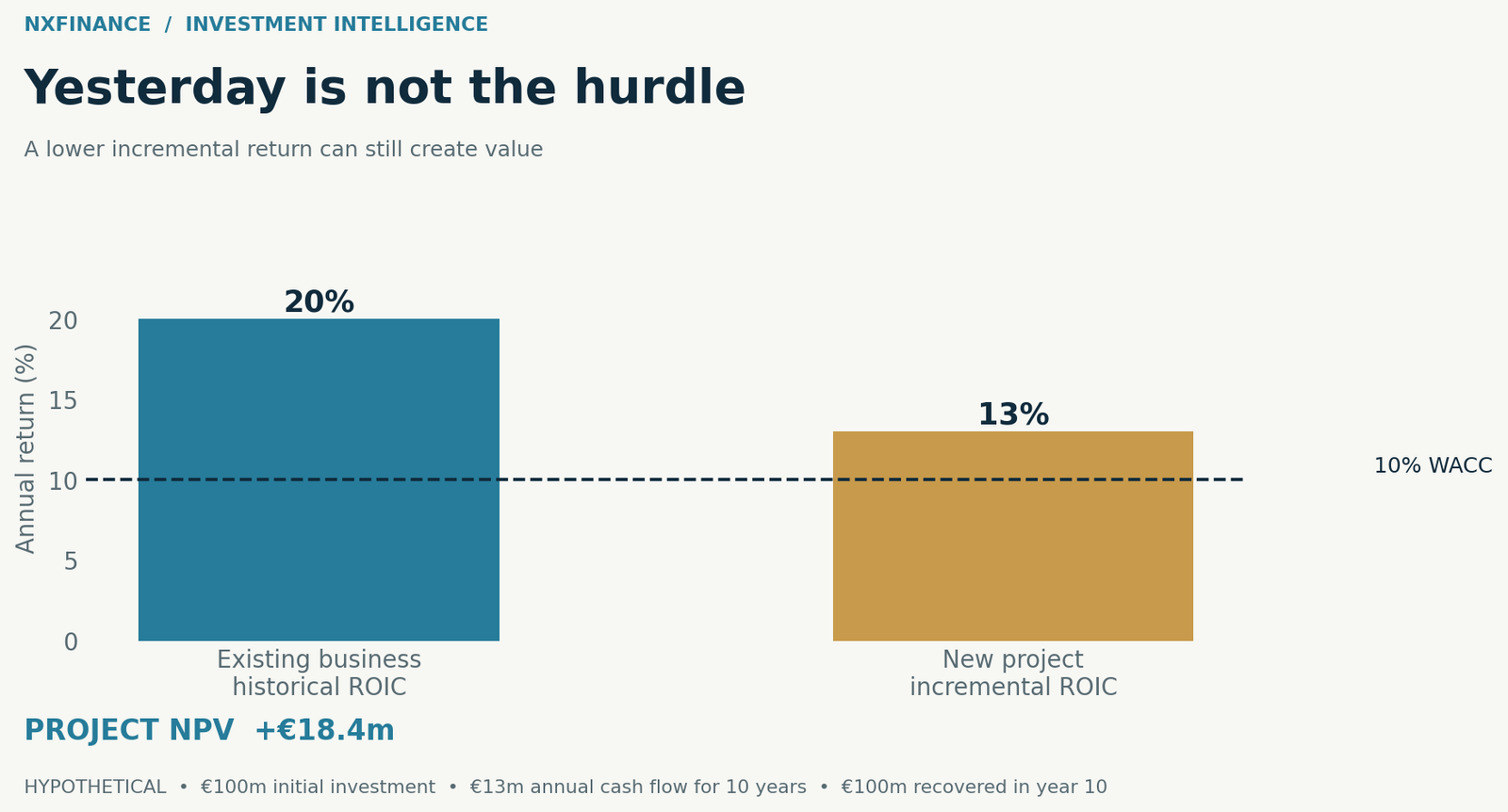
Now take the other case. The existing business earns 20% ROIC. Management can invest another €100 million in a new project expected to earn 13% annually on that capital. The project’s risk warrants a 10% cost of capital. Is 13% disappointing because the existing business earns 20%?
Not necessarily. The 20% describes the existing business. It does not prove that another investment of similar risk can earn 20%, or that the next euro placed into the old business will reproduce its history. The relevant comparison is the project’s prospective cash flows against its risk-adjusted opportunity cost and genuinely available alternatives.
Assume, purely to make the arithmetic transparent, that the project generates €13 million of NOPAT and free cash flow at each year-end for ten years and returns its €100 million of operating capital at the end of year ten. There is no growth, additional investment, inflation or tax effect beyond that already reflected in NOPAT. Discount those cash flows at 10% and the project has an NPV of approximately €18.4 million.
The board should still ask whether the 13% is achievable, whether the capital can really be recovered, whether the risks justify 10%, and whether a better feasible opportunity exists. But rejecting a positive-NPV project merely because it earns less than the historical business would confuse an observation about the past with a hurdle for the future.
Reverse the facts and the danger is equally clear. A celebrated 20% business may offer a new project that earns only 6% against a 10% cost of capital. Growth can make the company bigger while leaving its owners poorer than they would have been under a better alternative.
That is why the financial conversation cannot stop at earnings or historical ROIC. Incremental returns concern new capital. Free cash flow asks what remains after the investment required by the business. NPV relates expected cash flows to their timing and risk. A dividend, debt reduction, share repurchase, acquisition, expansion or divestiture is a competing use of resources—not a statement of identity. A buyback at the wrong price can disappoint; an acquisition can create value or transfer it to the seller; debt can fund opportunity while increasing vulnerability.
Financial precision does not make uncertainty disappear. It makes uncertainty harder to hide behind a profitable year.
The two challenges
The first challenge is familiar in economies where valuable resources, family ownership, political access or protected markets can create considerable wealth. How does control become productive investment? How does an enterprise move from defending a position to building capabilities that can compete beyond it?
These questions are not a description of all emerging economies. Many entrepreneurs in those markets build under difficult financing conditions, compete internationally and discover opportunities that established institutions overlook. Nor is a natural resource endowment automatically a curse. The challenge is whether institutions, incentives and choices convert an advantage into diversified capabilities, credible investment and opportunities for others. Resource wealth can fund schools, infrastructure and enterprise; it can also intensify competition for control of rents. Outcomes depend on policy and institutions, among other factors. [4]
Consider the ambitious business owner who can protect an existing operation through access to licenses or relationships. Protection may generate profits for years. It does not establish that the business could satisfy customers better than a competitor, earn its cost of capital without privilege, or deploy new investment effectively. Those are separate tests.
The second challenge appears in some of the world’s most sophisticated financial systems. They have boards, auditors, risk committees, investor presentations and models detailed enough to make a spreadsheet request parental leave. These mechanisms can protect capital. They can also become rituals that reward compliance with procedure more visibly than independent judgment.
A proposal may travel through every required committee and still depend on assumptions nobody has seriously challenged. A financial institution may optimize reported figures while missing a change in customer behavior. A board may approve a transformation because its peers have approved one. A spreadsheet can be flawless and still answer the wrong question.
The existence of bureaucracy does not prove it is excessive; controls often exist for good reasons. Nor is financial engineering always harmful: refinancing or restructuring can improve a company’s resilience. The issue is whether procedures remain instruments of judgment or become substitutes for it.
Evidence on long-horizon medical research shows why incentives matter even in sophisticated markets. Work by Budish, Roin and Williams finds that the structure of commercial incentives can favor shorter-horizon cancer research over longer-horizon projects with substantial potential benefit. That is a specific finding, not a verdict on all public companies. It demonstrates that money, expertise and advanced markets do not automatically finance every socially valuable possibility. [5]
The boundary does not run neatly between emerging and developed economies. It runs through institutions everywhere: between decisions exposed to evidence and those protected by status; between productive advantage and privilege; between patient commitment and inertia.
The guardians of capital
Banks know borrowers in ways public markets may not. They can provide financing and remain present through temporary setbacks. Their loan officers may also face pressure to avoid recognizing a loss. In Japan after the early-1990s asset-price collapse, research by Ricardo Caballero, Takeo Hoshi and Anil Kashyap linked subsidized lending to weak firms with depressed restructuring and adverse effects on healthier competitors. Joe Peek and Eric Rosengren documented incentives for troubled banks to extend credit to impaired borrowers. The studies identify mechanisms and associations; they do not show that every struggling borrower should be abandoned. [6]
A bank that extends a viable company’s runway may preserve value. A bank that repeatedly renews a loan solely to conceal losses can prevent that value from being honestly assessed. The difference is found in evidence, incentives and the credibility of the recovery plan—not in the word “patience.”
Boards have the mandate to supervise management, but may depend on the people they are meant to challenge for information. Shareholders can discipline decisions, but their time horizons and incentives differ. Institutional investors can fund scale, while agency chains separate the ultimate saver from the person voting on a board appointment. Markets gather dispersed views into prices; those prices can inform decisions, but bubbles and correlated beliefs show why a price is not a guarantee of truth.
Auditors add assurance about reporting. Financial experts compare alternatives and test assumptions. Courts enforce rights. Regulators set constraints and can intervene where private incentives produce systemic risk. Competition authorities can challenge the protection of rents. Each institution has useful knowledge and a failure mode: information asymmetry, conflicts of interest, capture, weak enforcement or the simple human preference for a conclusion that leaves existing arrangements undisturbed.
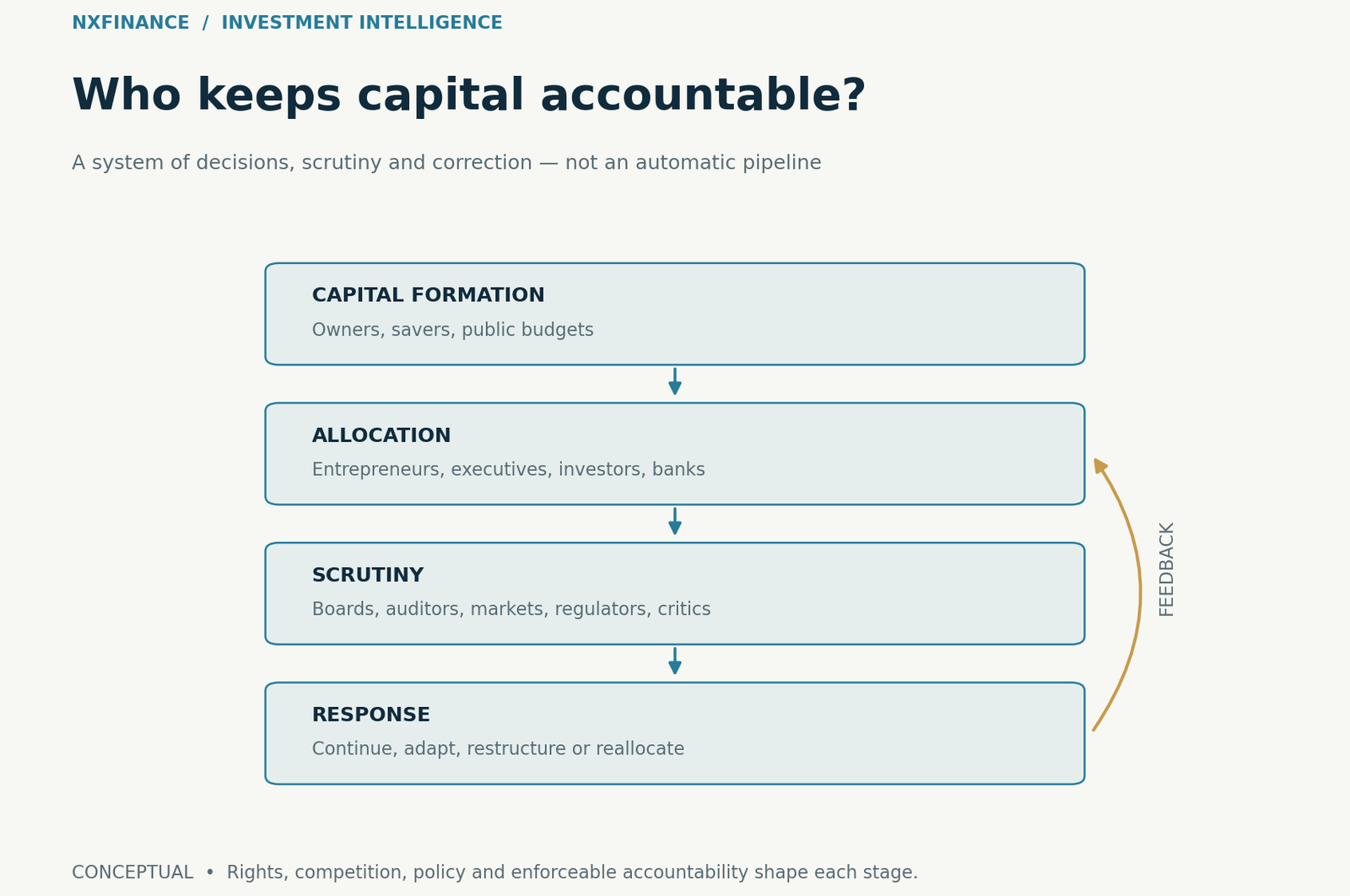
No single guardian sees everything. The important design question is whether one guardian can challenge another and whether those challenges have consequences.
That requires more than multiple committees. It requires information that can be checked, rights that can be enforced, independent voices that can be heard, and a genuine ability to revise or stop decisions. A creditor may demand a restructuring; a shareholder may vote or sell; a court may enforce a contract; a regulator may require a bank to recognize losses. Each mechanism has limits, costs and potential abuses. Together they can make capital less dependent on the judgment—or survival instinct—of one office.
Institutional change can also open the door to productive activity. Research on China’s pharmaceutical approval reform links improvements in approval times to changes in firm entry and increased research activity. That finding is not a general argument for removing regulation: in the case examined, the design and administration of a regulatory system changed the opportunities available to firms. [7]
Patience, stability and the uses finance cannot price
The freedom to reallocate capital is valuable. So is the ability to commit it for long enough to build something difficult.
A semiconductor plant, a transport network or a research program cannot be judged fairly only by this quarter’s cash flow. Abandoning a project prematurely can destroy knowledge and future returns. Keeping a failing project alive indefinitely can consume resources that might support better ones. Serious governance must be capable of both patience and correction.
The transition itself has costs. Closing a facility can release capital while disrupting workers, suppliers and communities. Those costs deserve attention even when they do not fall on the investor. And a high private return may reflect market power or pollution whose costs are paid elsewhere. ROIC does not measure civic virtue. It tells us something important about a business; it does not tell us everything important about a society.
Macroeconomic conditions matter too. Keynes emphasized demand and uncertainty; Friedman emphasized monetary forces and the consequences of monetary instability. Their work points to different mechanisms, and neither provides a universal response to every shock. A collapse in demand, a banking crisis, a supply disruption and persistent inflation require different diagnoses.
International capital can finance investment and transmit knowledge. It can also arrive quickly and leave suddenly, magnifying financial fragility. The IMF recognizes both benefits and risks, with outcomes shaped by domestic institutions, financing structures and policy. A society that attracts capital has not finished the job; it must also be able to absorb it and withstand shocks. [8]
Public goods add a further challenge. Some benefits of basic research, public health or environmental protection may not be captured by the investor who pays for them. Public financing, regulation or cooperation can therefore have a role. Those choices require scrutiny too: who benefits, who pays, what evidence will be used, and when will the policy be reconsidered?
The objective is neither to move all capital constantly nor to freeze it for the sake of stability. It is to create conditions in which commitments can be made, examined and, where justified, revised.
The open civilization
The Open Civilization is not a political blueprint or a claim to possess the correct answers. It is a proposed institutional principle: decisions that shape the allocation of capital should remain open to scrutiny, competing evidence and revision. The purpose is not to eliminate error, but to prevent authority from making error permanent.
Its premise is that no individual, institution or generation possesses enough knowledge to monopolize the future of others. Human dignity matters. Authority requires a mandate and limits. Discovery requires room to experiment and cooperate. Decisions carry responsibilities, including responsibility for consequences that may fall on people who did not make them. Future generations must retain meaningful options of their own.
The proposal is not a demand that every capital decision be made by a central council, a market vote or an algorithm. Different decisions require different mandates. A founder may invest personal funds. A pension trustee manages money for beneficiaries. An elected government allocates a public budget. Their authorities are not identical; neither are their obligations.
All can nevertheless be asked to explain the purpose of a commitment, the evidence behind it, its risks, the alternatives considered and the conditions under which the decision should change. Some information must remain confidential, and not every consequence can be quantified. Accountability is still possible without pretending every decision can be reduced to a single number.
A critic might object that openness favors those who already have wealth and connections. That objection matters. Formal freedom to compete is thin protection if contracts are unenforceable, information is inaccessible or powerful incumbents can exclude challengers. Another critic might argue that frequent challenges weaken long-term commitment. That matters too. Institutions must create space for patient investment without giving every project a permanent exemption from scrutiny.
The proposal is therefore a hypothesis about institutional design, not a promise of perfection: fallible people make better decisions when authority is bounded, knowledge can be contested and errors can be corrected without destroying the capacity to act.
The augmented decision-maker
Artificial intelligence makes this question more urgent. A system can search filings, compare scenarios, identify missing assumptions and help a team remember why an earlier decision was made. Used well, it can give a skilled professional a wider field of vision.
But analytical reach is not a mandate. AI can invent sources, mistake poor data for evidence or repeat an error across hundreds of apparently independent analyses. A board can become more confident because the output is polished. If executives, lenders and investors rely on similar systems, their errors may become correlated rather than diversified.
When a model recommends a project, someone must still decide whether the evidence is sufficient, whether the risks are acceptable and whether the commitment fits the mandate. When the analysis is wrong, responsibility cannot be transferred to a prediction engine. The tools should make the reasoning easier to inspect, not make the decision-maker harder to find.
The same demand for accountability extends beyond corporate boards and investment committees. The past two decades have offered no shortage of grand ambitions: financial stability, national security, energy independence, environmental transition and technological leadership. Each has attracted political authority, institutional conviction and enormous commitments of capital. Some investments will prove indispensable. Others may leave behind costs that were poorly understood, alternatives that were never seriously considered, or promises that outlived the evidence supporting them. The coming decades will demand even larger decisions. Who will test the assumptions, measure the trade-offs and retain the authority to change course?
The quality of capital allocation cannot be judged solely by the wisdom of the original decision. What matters is whether maintaining a commitment still offers greater expected value than the available alternatives, after accounting for future costs and risks. Past returns do not justify future investment, and past loyalties do not guarantee future value.
A wise institution knows where to commit its capital, whom to trust and whom to challenge. A wiser one knows when to change its mind. Yesterday’s ally can become a liability, yesterday’s adversary an opportunity, and yesterday’s best investment tomorrow’s most expensive mistake.
The original question asked what kind of person an institution might select for power. The more durable question is what an institution asks that person to do after receiving it.
Owning capital matters. Expertise matters. Models matter. None removes the obligation to explain why scarce resources are being committed to an uncertain future, whose rights and interests are affected, and what evidence would justify a change of course.
Financial discipline cannot define human progress. It can make the cost of our choices visible. Institutions cannot guarantee wise decisions. They can give wisdom, enterprise and criticism a better chance to matter.
A society’s strength is not measured only by the wealth it controls. It is also revealed by what it builds with that wealth—and by whether it can recognize when its own power has placed capital in the wrong hands, for the wrong purpose, for too long.
Sources, definitions and research notes
- Kiriakou interview, The Real News Network (2015).
- Gelderblom, de Jong and Jonker, The first bear raid and squeeze (2026).
- National Library of Scotland, Luca Pacioli and the origins of modern accounting (historical collection note).
- World Bank (2021), The Changing Wealth of Nations 2021: Managing Assets for the Future.
- Budish, Roin and Williams, Do Firms Underinvest in Long-Term Research?.
- Caballero, Hoshi and Kashyap, Zombie Lending and Depressed Restructuring in Japan; see also Peek and Rosengren, Unnatural Selection.
- Jia and coauthors, Improving Regulation for Innovation.
- IMF, Capital Flows and Capital Flow Management Measures: Benefits and Costs.
Figures 1 and 2 use hypothetical figures. Project analysis assumes end-of-year unlevered cash flows and full recovery of invested capital in year ten. Historical ROIC is not the investment hurdle. Financial returns do not measure social welfare.
Philosophical descriptions are interpretive summaries; the CIA anecdote is a reported conversation, not independent proof of a recruitment policy.
NXFinance Investment Intelligence — Independent research on financial economics, investment decisions and capital allocation.