
NXFinance / Investment Intelligence
Anthropic’s Trillion-Dollar Question
Growth Is Not Value Creation — Until Capital Earns Its Return.
Growth earns attention. Cash flow earns value. Anthropic may become an extraordinarily valuable business, but investors must underwrite the machinery that turns demand into cash. NXFinance examined its financial statements and tested its commercial trajectory against compute commitments and recurring investment, using Aswath Damodaran's public valuation as an external benchmark. The finding is consequential: commercial scale and timing can transform the economics, while shorter equipment lives can remove hundreds of billions of dollars of modeled operating value. The investment case remains conditional on demand, capital productivity and the claims ahead of ordinary shareholders.
The economics behind the loss
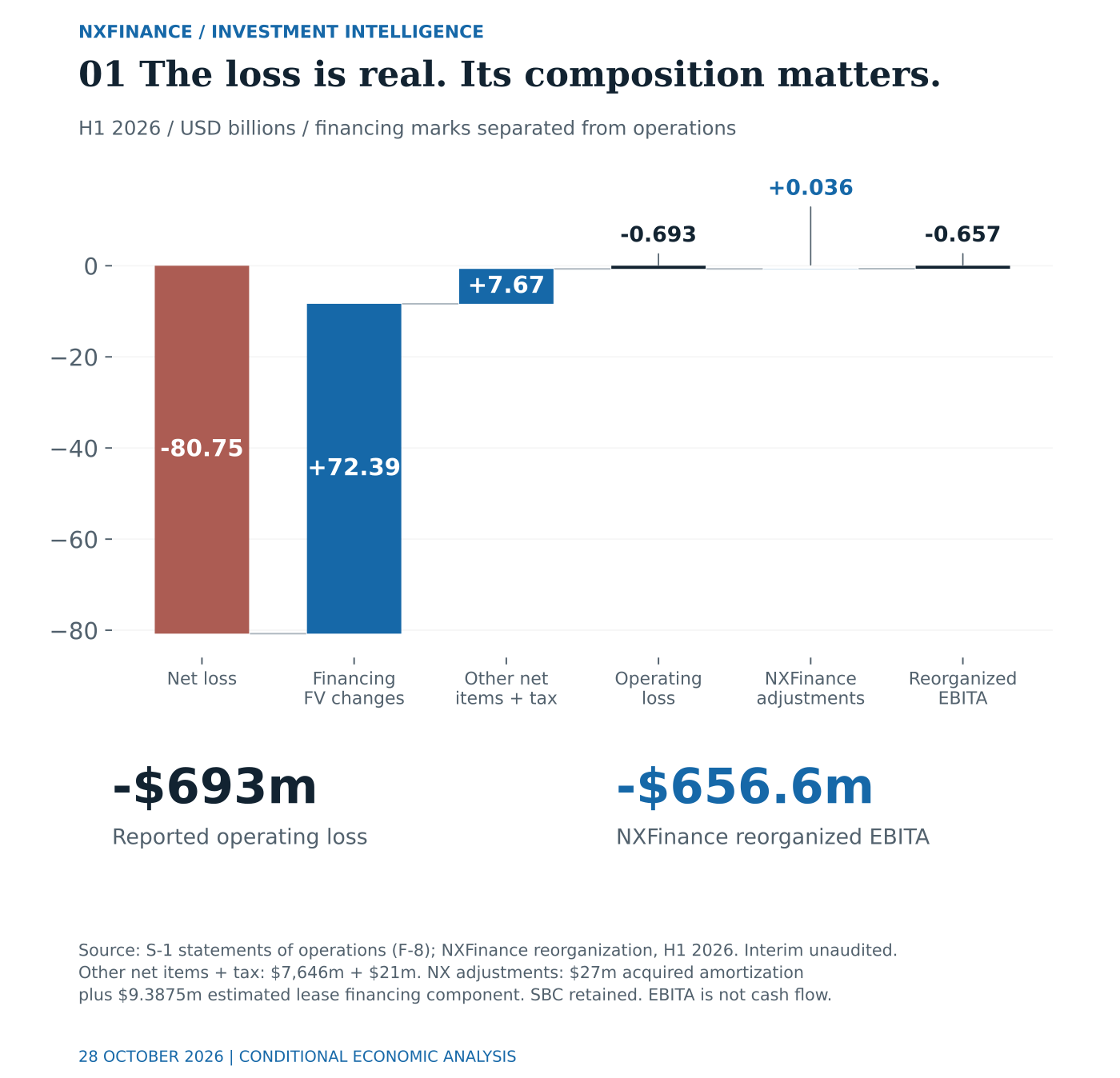
Anthropic reported a first-half 2026 net loss of $80.748 billion. Its reported operating loss was $693 million. Financing-related fair-value movements and other non-operating items explain most of the distance between those figures. Treating the headline net loss as the cost of running the business would misread the accounts. [1]
Our reorganization produces an EBITA loss of approximately $656.6 million after acquired-intangible amortization and an estimated lease financing adjustment. Stock-based compensation remains an economic expense. Employees receive a valuable claim even when the company does not immediately pay cash. [2]
The distinction sharpens the analysis; it does not establish cash profitability. The business still loses money on this operating measure, and the historical cash-flow reconciliation remains incomplete. A smaller operating loss is evidence about the present. It is not proof of the future.
The capital behind growth
Anthropic sells access to intelligence through subscriptions and usage-based services. Its economics depend on what customers pay, how much they consume and the cost of serving them while developing the next generation of models. Research protects the product. Compute delivers it. Both require resources before the ultimate commercial return is known.
Large capacity commitments can secure supply and support growth. They can also leave cash costs arriving ahead of profitable demand. Utilization matters because a service minimum can remain payable when customer spending disappoints. Pricing matters because more usage need not compensate for lower revenue per unit.
The classification matters too. Cloud services, equipment purchases and lease financing have different cash-flow consequences. An analyst cannot charge a service obligation fully in operating costs and then deduct its present value again as debt. Nor can equipment renewal disappear inside an attractive margin assumption. [3]
Our test is direct: what cash remains after delivering the service, funding research and replacing the productive assets required to stay competitive?
An attractive growth forecast must therefore survive a second test: recurring investment. If every advance in service quality requires another large round of spending, the investor needs evidence that collected revenue and contribution improve faster than that burden. Scale creates value only when the economics of the next investment support it.
The same rules can produce a different value
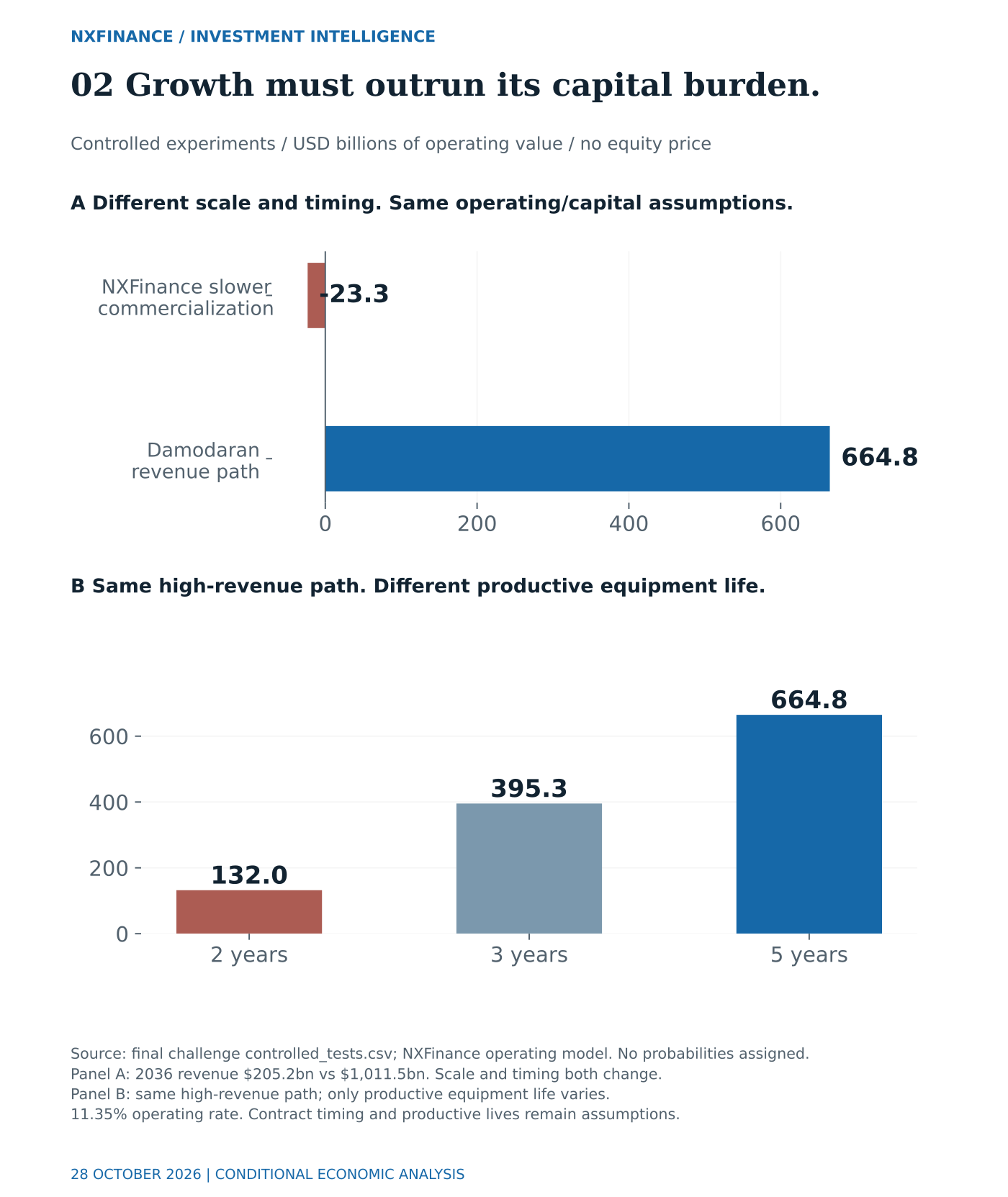
NXFinance's slower-commercialization scenario produces approximately negative $23.3 billion of operating value. Substitute Damodaran's much larger, faster revenue path while preserving our operating-cost and capital-investment assumptions, and operating value rises to approximately $664.8 billion. [2]
This is a controlled experiment. It is not a comparison of two prices for the same share, and it changes both commercial scale and timing. Our slower-commercialization scenario reaches $205.2 billion of revenue in 2036; the substituted path reaches approximately $1.011 trillion. The larger business absorbs committed capacity sooner and spreads fixed costs across more sales.
The result challenges an easy bearish conclusion. Compute commitments do not automatically destroy value. Their economics depend on the revenue and contribution they enable, the costs they make unavoidable and the time between commitment and monetization.
Then hold that high-revenue path fixed and shorten productive equipment life. Five years supports $664.8 billion of operating value. Three years reduces it to $395.3 billion. Two years reduces it to $132.0 billion. Earlier replacement absorbs cash that would otherwise be available to capital providers. A financing contract's duration cannot establish how long its equipment remains economically productive.
What a trillion-dollar valuation requires
Damodaran provides a serious external benchmark: an explicit commercial story connected to revenue, margins, reinvestment and risk. His workbook targets a business with approximately a trillion dollars of revenue in 2036. NXFinance's slower-commercialization hypothesis describes a much smaller market position and an exceptionally abrupt early slowdown. Neither trajectory becomes evidence because a spreadsheet can calculate it.
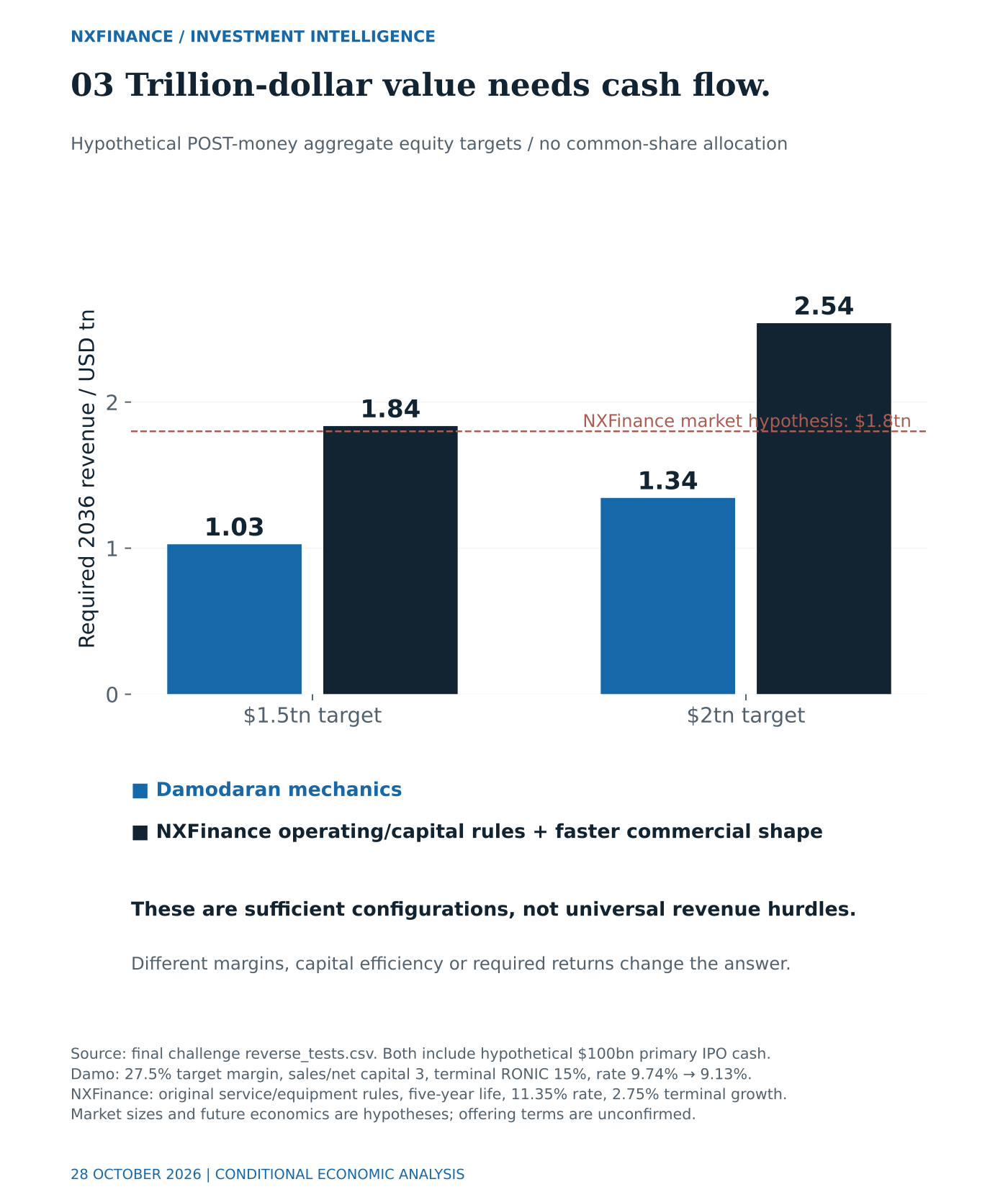
We therefore reverse the valuation. Under Damodaran's original margin, reinvestment and risk conventions, a hypothetical $1.5 trillion aggregate equity target requires approximately $1.03 trillion of 2036 revenue. Under our commitment-based operating model's cost and replacement rules, using the faster commercial shape, the same target requires approximately $1.84 trillion. The corresponding requirements for $2 trillion are about $1.34 trillion and $2.54 trillion. [2]
Both comparisons include the same hypothetical $100 billion of primary IPO cash. They do not establish an offering price, an ordinary-share value or a universally necessary revenue threshold. Different margins, capital efficiency and required returns produce different combinations.
The revenue requirements under our operating model exceed our hypothesized $1.8 trillion serviceable market. Supporting them therefore requires a broader market boundary or better operating economics. That is an additional investment thesis to substantiate. It cannot be smuggled into the model as a harmless adjustment.
The NXFinance judgment
The evidence supports a clear investment framework. Underwrite profitable demand against committed capacity. Test the cash cost of research and repeated equipment renewal. Then establish which capital providers own the resulting value.
Investors should monitor collected prices, customer consumption and retention, revenue per delivered capacity, replacement productivity and enforceable minimum payments. Improving these variables can strengthen the thesis. Weak utilization, faster obsolescence or persistent price pressure can break it, even when reported revenue continues to grow.
Our research supports substantial conditional value creation. It does not support a reliable ordinary common-share target today. Conversion terms, preferred and employee claims, primary issuance and cash-tax evidence remain incomplete. The prospectus and issuer announcement leave offering size and price undetermined at the reference date. [1][5]
Capital has to earn its return. Anthropic's opportunity is to build a business large and productive enough to do that repeatedly. The investor's job is to demand evidence that it can.
Sources, calculation notes and research limitations
Technical notes, sources and limitations
Reference date: 28 October 2026. Research mandate: 29 October 2026. This publication presents conditional economic analysis, not a calibrated expected value, ordinary common-share target or final investment recommendation.
[1] Primary filing. Anthropic, PBC, Form S-1 filed 26 October 2026, accession 0001628280-26-067168. Consolidated statements of operations: printed F-8. Revenue: Note 2, F-27. Options: Note 10, Stock Options, F-52, table shares in thousands. Leases: Note 7, F-35 onward; commitments: Note 13, F-59 onward; subsequent events: Note 17, F-65 onward. https://www.sec.gov/Archives/edgar/data/2130357/000162828026067168/anthropicpbc-sx1.htm
[2] Calculations. Existing NXFinance V2 and final challenge, preserved unchanged. Public-label traceability: NXFinance's slower-commercialization scenario is the original V2 Convergence commercial path ($205.2bn 2036 revenue; approximately negative $23.3bn operating value), not a statistically established base case. Our commitment-based operating model and our operating and capital-investment assumptions refer to the unchanged V2 economic rules. The high-revenue substitution and reverse-test configurations remain those defined in the original controlled_tests.csv and reverse_tests.csv; original V1/V2 model identifiers are retained in internal audit files. Public results are drawn from validated controlled_tests.csv and reverse_tests.csv. Operating values discount economic operating cash flows; they do not allocate preferred, convertible or employee claims. Revenue paths are hypotheses with no calibrated probabilities. Panel A changes scale and timing; it is not a pure timing test. The matched-path equipment-life test changes recurring replacement economics, not merely a depreciation label. Native desktop Excel validation was not completed; an independent formula replay and the artifact calculation engine were used. CORE did not execute this valuation.
[3] Commitment interpretation. Original disclosure amounts do not establish modeled payment timing, classification or productive lives. Gross commitment envelopes overlap. V2 models service expense as the higher of service floors and demand-based cost; hardware investment and lease financing are separated. The additional TPU estimate is provisionally modeled and can be absorbed by demand-based service cost. No independent real-option premium is added. A complete contract-ledger reconciliation is unavailable.
[4] Benchmark and isolated source checks. Aswath Damodaran's article, dated 28 October 2026: https://aswathdamodaran.blogspot.com/2026/10/the-anthropic-prospectus-arrives-ipo.html . Source workbook: https://pages.stern.nyu.edu/~adamodar/pc/blog/AnthropicIPO.xlsx . The supplied file matches that download. Input sheet B11 uses 5485 – 1163 + 16286 = 20608m, whereas disclosed FY2025 revenue is 4585m and correct TTM revenue is 19708m. Holding all growth rates fixed, the isolated correction lowers aggregate equity by approximately $75.6bn; it also lowers the future revenue endpoint. B39 uses 0.902m options, versus 902.727m vested/exercisable and 1797.066m total outstanding at June 2026 in Note 10. At the model's hypothetical $525 price, its own option convention gives a vested-claim sensitivity of approximately $472.3bn rather than $0.472bn. This is not an intrinsic employee-claim valuation or a jointly corrected equity estimate. Correcting units does not resolve all outstanding awards, forfeitures, conversion or dilution.
[5] IPO terms. Anthropic's 26 October announcement says the number of offered shares and price range have not been determined: https://www.anthropic.com/news/s1-sec . The $1.5-2tn targets and $100bn primary proceeds used here are hypothetical comparability conventions, not confirmed issuer terms. Reverse tests use different margins, discount rates, terminal returns and obligation treatments. V2's fast-path alternative retains its $53bn 2026 estimate but requires an abrupt subsequent expansion. Its $1.8tn market is an analyst hypothesis, not a verified forecast.
Residual limitations. Historical cash-tax NOPLAT is unresolved. The cash-route FCFF estimate differs from the mechanical capital-change route by $3.171bn; acquisitions, noncash investment, FX and tax allocation need reconciliation. V2's terminal return excludes research capital and must not be interpreted as proven full economic RONIC. Financing budgets are assumptions, not commitments or issuance-price forecasts. The incomplete failure-workout path is not approved for public recovery claims.
Methodology. Established DCF, financial reorganization, economic-profit and reverse-valuation methods, informed by Koller, Goedhart & Wessels and Damodaran. NXFinance's contribution is their integration into conditional capital-allocation analysis, not invention of the underlying methods.
Valuation reference: 28 October 2026. Conditional economic analysis; no ordinary common-share target or investment recommendation. Entrepreneurial Spirit. Institutional Discipline.