
NXFinance / Investment Intelligence
The High Cost of Being Wrong
Why more information, sophisticated finance and artificial intelligence are no guarantee of better capital allocation.
Modern organizations have acquired an extraordinary ability to measure almost everything. Revenues, productivity, margins, customer behavior, credit exposures and financial risks can be monitored with a precision unimaginable a generation ago. Boards receive detailed reports, executives consult specialists, and artificial intelligence can now produce a remarkably convincing financial analysis in seconds.
Yet some of the world’s most sophisticated institutions continue to make enormously expensive investment decisions.
A company can dominate its industry and consume billions in cash. A government can command substantial natural resources without converting them into enduring prosperity. A bank can meet its reporting requirements while accumulating risks that ultimately overwhelm its capital.
It would be comforting to dismiss these episodes as failures of intelligence. But that explanation is inadequate. Many involve talented executives, experienced financiers and institutions equipped with sophisticated analytical systems.
The more interesting question is whether organizations have become better at recording economic activity than at understanding the value it creates.
That distinction lies at the heart of capital allocation. It separates growth from prosperity, accounting profit from economic profit, and an attractive business from an attractive investment.
It also raises an uncomfortable question about the people making these decisions. Even when the economics are understood, are the incentives to act on them properly aligned?
The Reporting Trap
Accounting is indispensable to modern capitalism. Reliable financial records make commerce, governance, taxation and investment possible. But accounting is a foundation for economic judgment, not a substitute for it.
Consider a manufacturer reporting a 15% increase in operating profit. Revenues are growing, margins have improved, and management has exceeded its annual budget. The board receives an encouraging presentation. The finance department has done its job.
Or has it?
How much additional capital was required to generate those earnings? Did management improve productivity, or simply benefit from higher selling prices during inflation? Are customers becoming more profitable? Is working capital absorbing an increasing share of operating cash? Has investment in maintenance or innovation been deferred to flatter current results?
And what return will the next dollar invested actually earn?
These questions can produce a radically different interpretation of excellent reported results.
A business can increase EBITDA while destroying value if its investments consistently earn less than their required return. A bank can expand its loan portfolio while consuming disproportionate amounts of risk capital. A public enterprise can meet production targets while delivering an inadequate economic or social return on the resources committed to it.
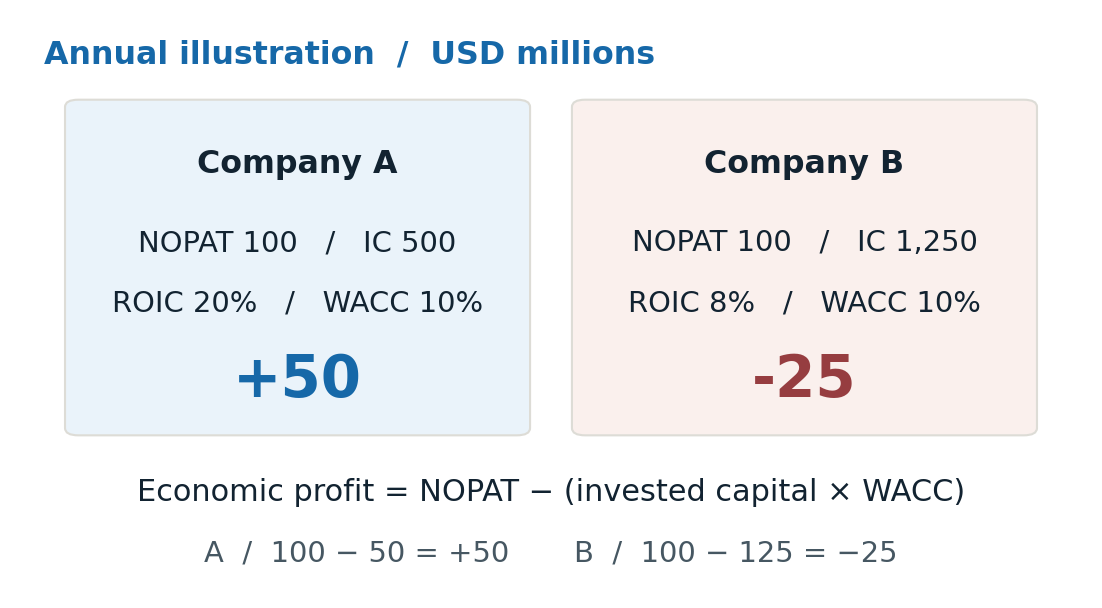
For a non-financial operating company, return on invested capital provides a useful starting point. It relates net operating profit after tax to the capital employed in the business. The difference between ROIC and the weighted average cost of capital helps determine whether that capital is earning more than investors require for the risk assumed.
But historical ROIC is only part of the answer. The crucial issue is the return on incremental investment.
An enterprise earning 18% on its existing capital may still destroy value by expanding into projects expected to earn 6% when the appropriate required return is 10%.
Growth is not the reward for investing. Growth is an opportunity to earn a return.
This is where conventional financial reporting often reaches its limits. It can describe yesterday’s profitability in impressive detail while offering remarkably little insight into the economics of tomorrow’s capital commitments.
And tomorrow is precisely where valuation begins.
Exhibit 1. Profit Is Not Economic Value
When Dominance Becomes a Dangerous Comfort
Boeing illustrates how formidable competitive advantages can coexist with profound financial and operational difficulties.
Commercial aircraft manufacturing is among the world’s most demanding industries. Engineering capabilities, certification requirements, supplier networks, customer relationships and capital intensity create extraordinary barriers to entry.
Yet Boeing reported a net loss of $11.8 billion in 2024 and negative operating cash flow of $12.1 billion, while carrying a total order backlog of approximately $521 billion. [Source]
The company retained a substantial industrial franchise and an enormous order book. Nevertheless, its financial performance reflected production disruptions, quality and safety problems, labor-related interruptions and charges on major programs.
Those results do not establish that one particular capital allocation decision caused the company’s difficulties. They demonstrate something more general: market position does not exempt an enterprise from the consequences of operational deterioration, investment requirements and weak cash conversion.
A backlog is not cash. A powerful brand is not a productive factory. And an industry with high barriers to entry can still impose extraordinary costs on a business that struggles to execute.
The financially relevant question is not simply when earnings will recover. It is what investments, operating improvements and financing arrangements will be necessary to restore sustainable economic returns.
Zillow provides a different but equally instructive case.
In 2021, the real estate technology company announced the closure of its Zillow Offers home-buying business after recognizing a $304.4 million inventory write-down in the third quarter. For the homes affected, carrying costs exceeded revised estimates of net realizable value, or expected selling prices less estimated selling costs. [Source]
This was a technology-driven business with sophisticated analytics and extensive market information. Yet understanding property markets did not make the economics of acquiring, holding and reselling homes attractive at scale.
Neither case proves that technology, financial sophistication or analytical models are ineffective. Both show that a sophisticated organization can misjudge the economic consequences of deploying capital.
The distinction is essential.
An excellent business model can become an unattractive investment at the wrong price. A dominant franchise can deteriorate when its productive capabilities are not maintained. And a compelling strategy can disappoint shareholders when the cost of implementing it exceeds the value ultimately created.
The investment community has known these principles for decades. Their repeated violation suggests that knowing them is not quite the same as applying them.
Capital Has No Ideology. Allocation Has Consequences.
The challenge becomes more complicated when capital allocation extends from corporations to governments and public institutions.
Public ownership versus private ownership. Industrial sovereignty versus international integration. State intervention versus market discipline. Conventional finance versus alternative contractual arrangements.
These debates involve legitimate political, strategic and ethical considerations. But they become economically sterile when ideological labels replace an examination of the mechanisms involved.
A state-owned company does not become efficient merely because its shareholder is the government. Nor does a privately owned business acquire an economic advantage simply through its ownership structure.
Public enterprises can deliver substantial social and economic value. Private companies can destroy it spectacularly.
Ownership establishes rights and responsibilities. Performance must still be demonstrated.
The same distinction applies to financing structures. A transaction without conventional interest can satisfy important ethical or religious principles while retaining a substantial economic cost of funding. A leasing arrangement, a profit-sharing partnership and an interest-bearing loan distribute risks, obligations and cash flows differently.
Those differences deserve careful analysis. Rejecting one contractual form does not eliminate financing costs, liquidity constraints or commercial uncertainty.
The purpose of financial analysis is not to invalidate legitimate values. It is to establish the economic consequences of pursuing them.
Consider natural-resource wealth.
Norway developed an institutional framework through which the state’s net cash flow from petroleum activities goes into a globally diversified investment fund. The fiscal guideline links transfers to the budget over time to the fund’s expected real return, estimated at 3%, with room to respond to economic conditions. The objective is to preserve financial resources for future generations. [Source]
The mechanism is important. A finite underground resource is progressively transformed into a portfolio of financial assets with the potential to support public expenditure beyond the productive life of the original resource.
Norway illustrates one way to turn temporary commodity income into lasting wealth. The right allocation depends on each country’s development needs, fiscal capacity, and social responsibilities.
They nevertheless raise a fundamental allocation question.
How effectively does a resource-rich economy transform temporary commodity income into productive capacity, human capital, resilient institutions and durable national wealth?
A government must finance education, healthcare, infrastructure and security, often for reasons that cannot be expressed adequately as corporate cash flows. Public investment requires a broader assessment of social benefits, distributional effects and strategic objectives.
But opportunity cost does not disappear because an investment is public.
Resources committed to one project are unavailable for another. Financial commitments constrain future choices. Debt service, maintenance obligations and operating subsidies can outlive the political enthusiasm that originally supported an investment.
Natural resources create possibilities. Capital allocation determines how many of those possibilities become lasting economic capabilities.
The serious debate is therefore not whether the state should be powerful or whether markets should be free. It is how ownership, incentives, financing mechanisms and institutional arrangements contribute to the outcomes society actually seeks.
Who Benefits When Capital Is Allocated?
Even an economically sound analytical framework cannot eliminate a more difficult problem: the objectives of those allocating capital may differ from the objectives of those providing it.
Shareholders may seek long-term returns. Executives may face short-term performance targets. Creditors prioritize repayment. Employees value stability. Governments must balance prosperity with social obligations, security and competing political commitments.
These interests are not necessarily incompatible. But neither are they automatically aligned.
An acquisition may strengthen competitive capabilities, or it may expand an executive’s empire without adequately rewarding shareholders. A public investment may address a genuine national priority, or it may persist long after its economic justification has weakened.
The financial statements alone rarely reveal the underlying incentives.
This is where institutions matter.
Markets are imperfect instruments for discovering economic value. Prices can become detached from fundamentals, credit can be mispriced, and speculative enthusiasm can persist far longer than a skeptical analyst expects.
But functioning markets possess an important characteristic: they create opportunities for independent participants to disagree about value.
A lender may demand stronger protection against risk. A shareholder may challenge management’s investment assumptions. A competing enterprise may demonstrate a more productive use of capital. A minority of investors may recognize a deteriorating business model before the broader market accepts the evidence.
No participant needs to possess the whole truth.
What matters is that competing interpretations can be expressed, examined and tested.
This requires more than a trading venue. Credible disclosure, enforceable property rights, reliable financial statements, independent scrutiny and effective governance are indispensable. [Source]
Where these mechanisms are weak, prices may convey less useful information and errors can remain concealed for longer. Capital may also demand a higher return to compensate for uncertainty over information, convertibility, legal rights or institutional reliability.
The implications extend to sovereign debt.
A rising public debt ratio is not necessarily evidence of poor investment decisions. Borrowing may finance productive infrastructure or support an economy through a severe downturn. Equally, low debt is no guarantee of sound management when public assets are deteriorating or future obligations remain poorly documented.
The relevant question is what the financing supports, what obligations it creates and whether the expected benefits justify those commitments.
Neither the market price of an asset nor the size of an institution’s debt provides an infallible verdict on capital allocation.
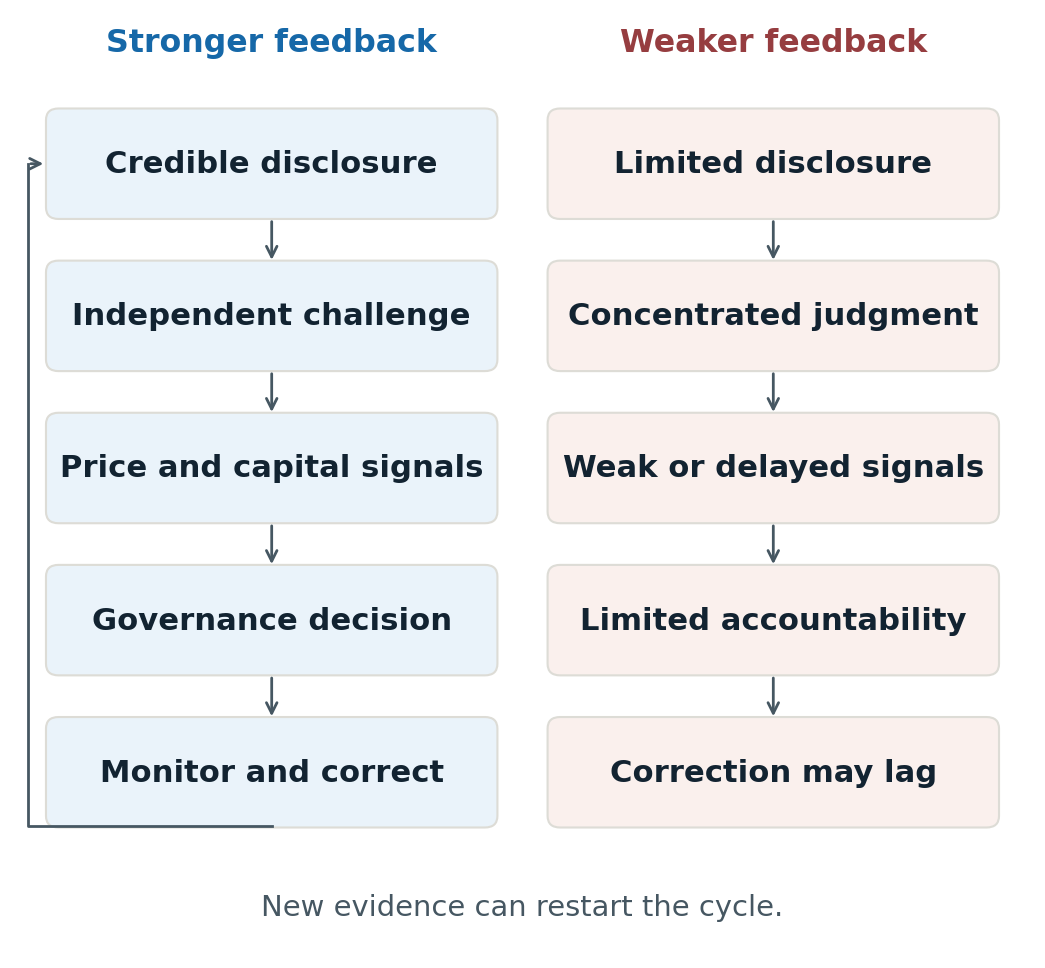
The strongest safeguard is not the assumption that decision-makers will always be right. It is an institutional capacity to discover when they are wrong.
Transparency makes evidence available. Independent analysis challenges prevailing interpretations. Governance establishes responsibility. Financial constraints encourage difficult choices. Where these mechanisms function, even a small minority can sometimes identify a problem that the majority has overlooked.
Correction is never guaranteed. Entrenched interests can resist evidence, and markets themselves can sustain mistaken valuations for years.
But an error that can be observed, challenged and corrected is fundamentally different from one protected by institutional opacity.
The objective is not to remove human imperfections from economic decisions. That would be an ambitious undertaking.
It is to prevent those imperfections from becoming permanent features of the capital allocation system.
Exhibit 2. The Institutional Feedback Loop
Value Creation Is an Economic System
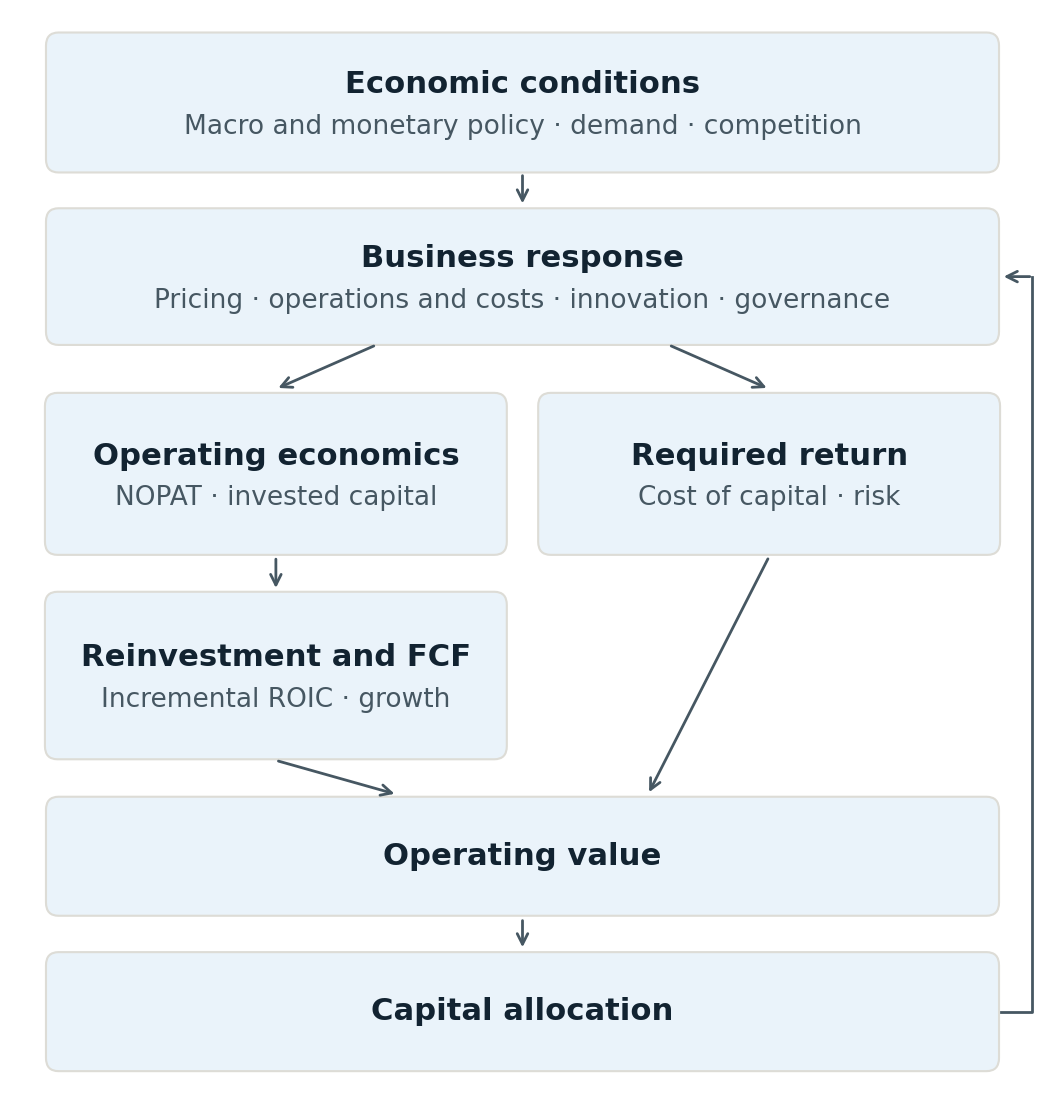
A company’s financial performance cannot be separated from the economic environment in which it operates.
Monetary policy affects financing costs, asset prices, exchange rates and demand. Inflation changes nominal revenues, purchasing power, replacement costs and working capital requirements. Commercial strategy determines customer economics and pricing power. Innovation influences productivity, technological relevance and competitive advantage.
Capital structure governs financial flexibility and resilience. Governance influences which opportunities are pursued and which warnings receive attention.
All these forces ultimately affect the cash flows available to capital providers.
Consider a business operating in an environment of rising interest rates. The immediate valuation response might be to increase its discount rate.
But the consequences rarely stop there.
Higher financing costs can reduce demand, weaken customer creditworthiness and alter supplier terms. Management may respond by changing prices, reducing inventories, delaying investment or redesigning its financing structure. Competitors may react differently, potentially changing market shares and long-term profitability.
A higher WACC captures part of the economic adjustment. It does not capture the whole business response.
Innovation introduces another complication. Cutting research expenditure may improve current reported margins while weakening future competitiveness. Increasing research expenditure may strengthen long-term opportunities but consume capital without producing a commercially viable return.
Neither innovation nor cost reduction is automatically valuable. Their contribution depends on future incremental returns.
Valuation provides a framework for connecting these moving parts.
Operating forecasts must be consistent with capital requirements. Growth assumptions must reflect reinvestment and productivity. Financing costs and risks must be incorporated without double-counting. Terminal value must correspond to a credible long-term economic position.
The objective is not to produce an impressive number. It is to understand the economic mechanisms that determine that number.
This distinction becomes particularly important when expected returns are distant, infrastructure is expensive and technological change is rapid.
Exhibit 3. The Economics of Value Creation
What Our Anthropic Valuation Actually Tells Us
Our research into Anthropic provides a useful illustration of why valuation is both indispensable and inherently conditional.
The commercial opportunity in artificial intelligence is extraordinary. But its economic value cannot be established by estimating demand alone.
A frontier AI business must finance research, acquire or contract computing capacity, deliver reliable services and remain competitive as technology evolves. Revenue growth may be exceptional while cash generation remains constrained by the cost of sustaining that growth.
The investor’s question is therefore straightforward: how much economic value remains after the business has paid for the infrastructure, research and reinvestment required to deliver its services?
In October 2026, NXFinance examined Anthropic’s prospectus and developed conditional valuation scenarios alongside Aswath Damodaran’s publicly available analysis. [Source]
Anthropic’s November filing shows why the distinction matters. GAAP operating income of $974 million in Q2 turned into a $567 million operating loss in Q3, even as the GAAP net loss narrowed from $66.309 billion to $23.291 billion. A smaller non-operating fair-value charge on convertible notes, derivative liabilities and SAFEs explains most of the improvement in net income. The operating result moved in the opposite direction.
Anthropic quarterly operating performance
| Reported line | Q2 2026 | Q3 2026 |
|---|---|---|
| Revenue | +11,555 | +16,956 |
| Operating expenses | −10,581 | −17,523 |
| GAAP operating income (loss) | +974 | −567 |
| Interest income | +762 | +1,248 |
| Fair-value change on convertible notes, derivatives and SAFEs | −59,597 | −21,936 |
| Other non-operating income (expense), net | −8,448 | −1,640 |
| Income tax expense | 0 | −396 |
| GAAP net income (loss) | −66,309 | −23,291 |
Damodaran’s model contemplated approximately $1 trillion in annual revenues by 2036, substantial operating margins and a published aggregate equity estimate of approximately $1.475 trillion, including $100 billion of hypothetical primary issuance proceeds. [Source]
Our work explored different commercialization trajectories and modeled the economics of compute commitments and recurring infrastructure investment more explicitly.
Under our slower-commercialization scenario, the model produced approximately negative $23.3 billion of operating value. This represented a modeled economic shortfall, not a negative market price for shares.
We then substituted a much larger and faster commercial trajectory while retaining our operating-cost and capital-investment framework.
The resulting operating value increased to approximately $664.8 billion.
That difference was not evidence that one forecast was correct and another foolish. The exercise changed commercial scale and timing, while retaining a common set of operating and investment rules.
It demonstrated how profoundly commercialization assumptions can affect the value of committed infrastructure.
We then conducted a more controlled sensitivity test.
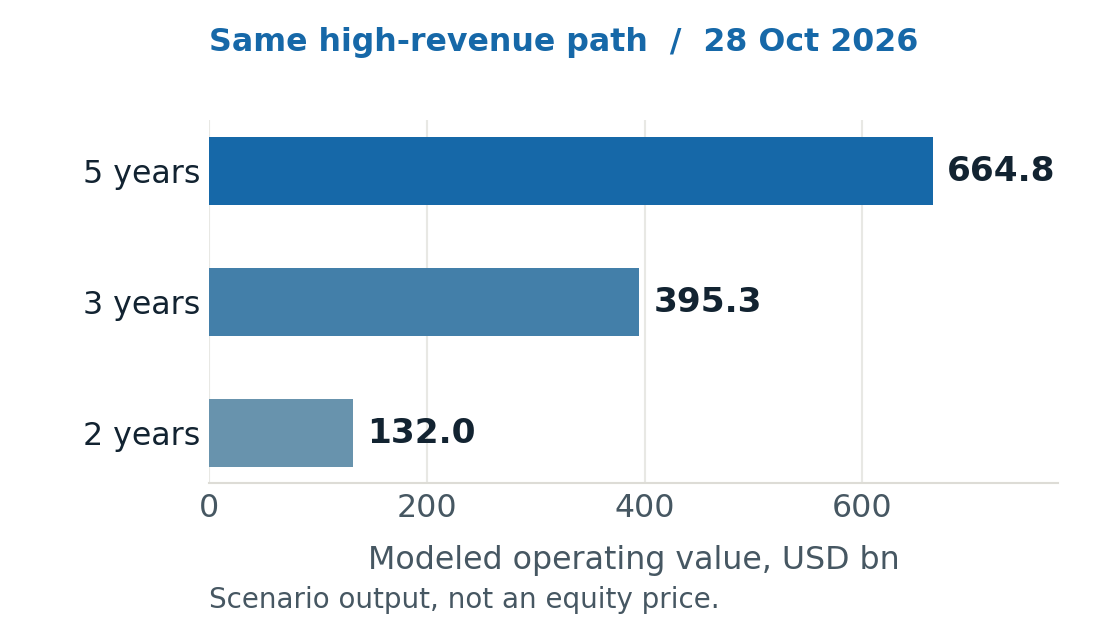
Holding the high-revenue trajectory and the other relevant modeled assumptions fixed, we varied the economic life of computing equipment.
With a five-year productive life, the modeled operating value was approximately $664.8 billion. At three years, it fell to $395.3 billion. At two years, it declined to $132.0 billion. [Source]
The difference was enormous.
And it had nothing to do with changing the company’s name, its management or the underlying appeal of artificial intelligence.
It reflected the capital required to replace productive assets more frequently.
This is an important distinction. Equipment life is not simply a depreciation convention. In a capital-intensive technology business, economic obsolescence can determine how often investment must be repeated before investors receive the cash flows they expect.
Nor do these figures represent directly comparable common-share valuations. Operating value, aggregate equity value and the value attributable to particular securities are different measures. Compute-service commitments, hardware investment, leases, preferred securities, employee compensation and new financing must be treated consistently.
Our research also identified unresolved issues in the historical cash-flow reconciliation, some contractual classifications and the allocation of economic value across capital claims.
Those limitations are material. We did not turn them into an invented ordinary-share price.
We also examined valuation in reverse: rather than asking how much Anthropic might be worth under a selected growth forecast, we asked what commercial performance would be required to support particular hypothetical equity values.
Under our more explicit cost and replacement assumptions, supporting a hypothetical $1.5 trillion aggregate equity target required approximately $1.84 trillion of annual revenue by 2036, given the specified model conventions, including $100 billion in hypothetical primary issuance proceeds. That exceeded the $1.8 trillion serviceable-market hypothesis used in our scenario.
The result did not demonstrate impossibility. A broader market, stronger margins or superior capital efficiency could change the economics.
But each would require an additional investment thesis supported by evidence.
This is what valuation is supposed to accomplish.
It is not an exact science capable of forecasting future market prices with certainty. Nor is it an arbitrary exercise in which every assumption is equally defensible.
Valuation is a disciplined attempt to convert a business narrative into explicit economic consequences.
The calculation can be precise while its inputs remain uncertain. The analyst’s responsibility is to distinguish the two.
Our Anthropic research does not establish that an optimistic or pessimistic market narrative must prevail. It identifies the operating conditions, reinvestment needs and financial assumptions under which substantial value could be created — and the conditions under which that value could erode.
That is why we conduct investment research.
Not to predict every market movement, defend a preferred conclusion or produce an impressive target price.
We want to understand what must happen for an asset to justify its valuation, which assumptions matter most, and what evidence would compel us to revise our judgment.
A useful valuation is not one that cannot be challenged.
It is one that makes the challenge possible.
Exhibit 4. Anthropic — Economic Life and Operating Value
Risk Is Not a Number in a Spreadsheet
Modern finance has developed exceptionally useful quantitative instruments. Expected returns, factor models, credit spreads, default probabilities, stress tests and Monte Carlo simulations can improve financial decisions.
But measuring a risk is not equivalent to controlling it.
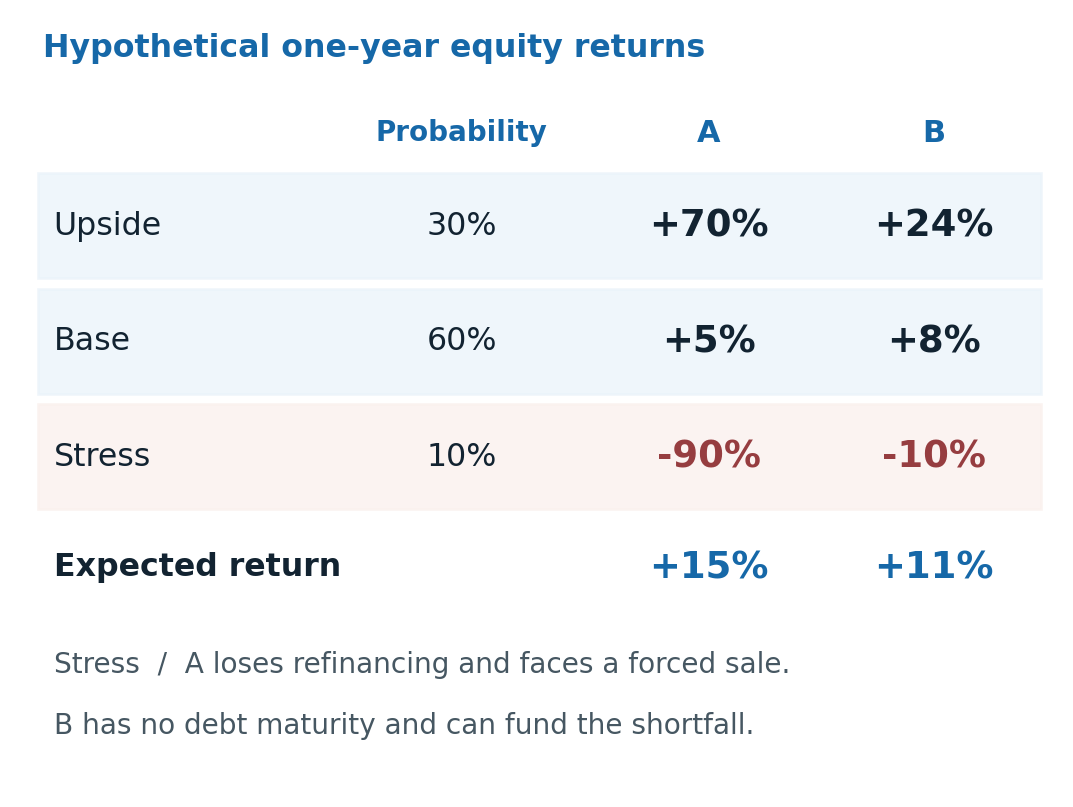
A discount rate cannot absorb every uncertainty that an analyst prefers not to examine. A 15% expected return is not necessarily superior to an 11% return. A financially attractive acquisition can become disastrous if its owner cannot survive the period required to realize its benefits.
The distribution of outcomes matters. So do leverage, concentration, refinancing obligations, liquidity and the possibility of permanent capital impairment.
Credit Suisse’s exposure to Archegos illustrates the difference between sophisticated risk infrastructure and effective risk governance.
Following Archegos’s default in 2021, the bank incurred approximately $5.5 billion in losses. The board special committee’s investigation identified failures of management and controls in the Investment Bank, particularly Prime Services, alongside failures of escalation and accountability. [Source]
The institution possessed sophisticated systems and experienced personnel. Significant warnings nevertheless failed to produce adequate corrective action.
The lesson is not that quantitative models are useless. It is that an analysis has little protective value when its findings are misunderstood, disregarded or disconnected from decisions.
An investor considering a leveraged acquisition must examine more than its expected internal rate of return. What happens if the anticipated synergies arrive two years late? Can the debt be refinanced? How much additional equity might be required? What is the asset worth if it must be sold under unfavorable conditions?
Risk analysis should connect possible losses to the ability to withstand them.
And the process must remain open to evidence that contradicts the original investment thesis.
Exhibit 5. Expected Return Is Not the Whole Risk
Artificial Intelligence Is Not an Investment Committee
Artificial intelligence has dramatically reduced the cost of producing financial analysis.
Tasks that once required hours of reading, extracting and organizing information can now be completed much faster. Financial statements can be interpreted, valuation methodologies explained, assumptions challenged and competing scenarios explored through ordinary conversation.
This is a significant advance.
But it introduces an uncomfortable possibility: confusing analytical fluency with analytical verification.
Ask an AI assistant to justify an acquisition, and it may develop a convincing argument based on strategic fit, commercial opportunity and potential synergies. Ask it to challenge the same acquisition, and it may produce an equally polished case against the transaction.
Neither response establishes that the underlying financial information has been reconciled, that the operating assumptions are economically consistent or that the acquisition price can be justified.
A sophisticated explanation is not automatically reliable evidence.
And the problem predates artificial intelligence. Investment committees have approved costly mistakes with distinguished advisers, experienced executives and meticulously prepared financial models.
AI can accelerate research and analysis. It cannot, by itself, repair inadequate governance, contradictory incentives or weak economic reasoning.
The opportunity is to use it within a disciplined process: traceable sources, consistent classifications, transparent assumptions, reproducible calculations, appropriate financial controls and meaningful human scrutiny.
A sound decision system should connect the origin of a financial figure to its economic interpretation and then to the capital decision it informs.
For corporations, this means linking investment forecasts to incremental ROIC, reinvestment and free cash flow.
For banks, it means examining capital consumption, credit quality, funding costs and risk-adjusted profitability. A bank may grow net interest income while accumulating losses or consuming capital in ways that ultimately weaken the returns available to shareholders.
The relevant financial framework must reflect the economics of the institution. Conventional industrial ROIC cannot simply be transplanted into a bank.
What matters is the discipline of understanding where value originates, who receives it and what risks are borne along the way.
The next competitive advantage in financial analysis may therefore come less from producing answers faster than from making the evidence behind those answers more reliable, transparent and actionable.
Further Research
Anthropic — What the Operating Economics Can Support
Explore the methodology behind our research: reported operating performance, DCF assumptions, compute reinvestment, equipment-life sensitivities and valuation limitations.
From Financial Reporting to Economic Intelligence
Financial reporting establishes an essential record of economic activity. Economic intelligence attempts to connect that record with competitive dynamics, financial conditions, institutional incentives and the consequences of alternative decisions.
The purpose is not to predict the future with certainty.
It is to recognize material changes early enough for decision-makers to respond while meaningful choices remain available.
A deteriorating incremental ROIC may reveal that a growth strategy is losing economic productivity. Increasing working capital requirements may expose weakness concealed by rising revenues. Persistent refinancing needs may indicate that an investment’s commercial development is taking longer than its financial structure can comfortably support.
An acquisition may look attractive under management’s assumptions but become difficult to justify once realistic integration costs, delayed synergies and financing constraints are considered.
These observations are valuable because they link analysis to action.
Should an organization invest, acquire, restructure, divest, refinance or retain liquidity? What changes in the evidence would alter that choice? How much capital is exposed if the original assumptions prove wrong?
The quality of a decision depends not only on the sophistication of its models, but also on whether the organization can confront unwelcome results and act accordingly.
This is the discipline behind NXFinance’s work in valuation, investment research, executive advisory and financial decision systems.
Our research examines the economic assumptions that determine asset values. Our advisory work brings independent analytical scrutiny to consequential investment decisions. CORE is designed to structure corporate valuation and value-creation analysis, while Banking Value System applies a dedicated framework to banking performance, risk-adjusted returns and capital allocation.
These activities share a common purpose: to make financial information more useful for decisions that commit capital.
The objective is not to replace executive judgment with an algorithm, nor to promise that every investment can be made successful.
It is to make assumptions visible, trade-offs intelligible and the economic consequences of decisions easier to examine before capital is irreversibly committed.
Markets will change. Technologies will evolve. Political priorities will shift. Entire industries will emerge, mature and occasionally disappear.
The discipline of capital allocation remains remarkably consistent.
Understand the asset. Understand the cash flows. Understand the capital required, the alternatives available and the risks being assumed. Then determine whether the expected economic benefits justify the commitment.
No model can eliminate uncertainty. No institution can eliminate human error. No market can guarantee that every asset is correctly priced.
But organizations can develop the analytical and institutional capacity to recognize when their assumptions no longer hold, when their investments cease to earn adequate returns and when a different allocation of capital becomes necessary.
That capacity may be far more valuable than the next dashboard, the next forecasting system or the next beautifully presented investment memorandum.
The real danger is not that decision-makers sometimes get it wrong. They inevitably will.
It is building organizations in which mistakes become difficult to identify, uncomfortable to challenge and prohibitively expensive to correct.
Your organization knows what it earned last year. But does it know which decisions are creating value today — and which ones are quietly destroying tomorrow’s returns?
NXFinance — Valuation, Capital Allocation & Investment Intelligence.
Research and financial decision-support capabilities: nxfinance.net.
Research Sources and Methodological Notes
Boeing. Fourth Quarter and Full Year 2024 Results, January 28, 2025. Reported net loss of $11.829 billion, operating cash outflows of $12.080 billion and backlog of $521 billion. The discussion does not attribute these outcomes to a single cause or imply misconduct. Boeing Investor Relations and SEC earnings exhibit.
Zillow Group. Third Quarter 2021 Financial Results, November 2, 2021, and the company’s corresponding SEC Form 10-Q. The $304.4 million inventory write-down related to Zillow Offers purchases above revised estimates of net realizable value. Zillow Investor Relations and SEC inventory disclosure.
Norwegian sovereign wealth framework. Norges Bank Investment Management, About the Fund, and the Norwegian Ministry of Finance’s fiscal-policy framework. These explain the transfer of petroleum income into financial assets and the fiscal rule guiding the long-term use of fund resources. Norges Bank Investment Management and Norwegian Ministry of Finance.
Credit Suisse and Archegos. Report of the Board Special Committee on Archegos Capital Management, July 29, 2021. The independent investigation documents approximately $5.5 billion in losses and significant weaknesses in risk management and accountability. SEC-hosted investigation.
Corporate governance. OECD, G20/OECD Principles of Corporate Governance, 2023. Institutional reference for disclosure, shareholder rights, board accountability and effective corporate governance. OECD.
Anthropic — primary information. Anthropic, PBC, Form S-1 filed October 26, 2026. Financial disclosures, leases, commitments, securities and governance information form the primary documentary foundation. October 26 SEC filing. The quarterly exhibit uses the November 10 Form S-1/A. The October valuation scenarios retain their original assumptions.
Anthropic — external valuation benchmark. Aswath Damodaran, The Anthropic Prospectus Arrives: My (but not the) IPO Valuation!, October 28, 2026. The October 28 essay reports approximately $1.475 trillion of aggregate equity value. The workbook linked from that essay, retrieved November 10, 2026, shows approximately $1.451 trillion in its saved valuation output. The figure in this article refers to the published essay. Musings on Markets and valuation workbook.
Anthropic — NXFinance research. Anthropic’s Trillion-Dollar Question, October 2026, and the associated NXFinance valuation challenge. The operating values and reverse-valuation requirements cited in this article are conditional model outputs, not calibrated forecasts or recommendations. The high-revenue replacement sensitivity uses five-, three- and two-year productive equipment lives. It does not establish actual hardware life or future market value. Historical cash-tax allocation, commitment classification and possible overlaps, and the allocation of value across preferred, employee and common claims remain unresolved. In the historical first-half 2026 analysis, the cash-based and capital-change approaches to free cash flow differed by approximately $3.171 billion. The underlying valuation was not executed by CORE.
Valuation methodology. Established discounted cash-flow, economic-profit, financial reorganization and reverse-valuation principles, informed by Koller, Goedhart and Wessels and by Aswath Damodaran. Economic profit illustrations are simplified. Public-sector investment assessment additionally requires social and distributional analysis beyond corporate financial returns.
This publication is independent economic research and commentary. It does not constitute an investment recommendation, a fairness opinion or a guarantee of future performance.